In a recent issue of Zymurgy Magazine (May/June 2025) there was a 9-page article about the past and present of pilsners made in Alsace. The timing was fortuitous as I was about to leave for a conference in Strasbourg, the capital of Alsace. What follows are my notes on beer culture in Alsace and the local variety of pilsner. It was the first stop on a 19 day swing through Central Europe, so this post is the first instalment in a series of posts from an amazing trip.
Getting to Strasbourg
Although Strasbourg is a city of nearly 2 million people, it’s not a terribly convenient place to fly into. As far as I can tell most people arrive either by rail or bus. If coming from outside of Europe, the first step is to fly somewhere close enough to catch a train to Strasbourg. The closest international airports are Paris and Frankfurt. My wife (Laurinda) and I decided to fly into Frankfurt, stay overnight to recover from the transatlantic flight and then travel onto Strasbourg by rail.
We arrived on a Saturday morning and checked into a hotel near the airport. After a few hours of napping we headed downtown to check out Frankfurt. Like many German cities, Frankfurt was badly damaged by allied bombing during WWII, but unlike most German cities they chose to rebuild with a modern view. Hence, Frankfurt is the only German city I’ve visited with a skyline that resembles an American city. In fact, the Germans refer to Frankfurt am Main as “Maimhattan.” There is however, a small section of the downtown called Neue Altstadt (New Old Town) that was rebuilt to look old. This seems like as good a destination as any for the afternoon.
It doesn’t take too long to explore the “old town” and the banks of the River Maim, especially on a cloudy, drizzly afternoon in late May. Before too long it was time for some dinner and liquid refreshment. For a German city Frankfurt is surprisingly sparse on local selections of beer. Apfelwein (Apple wine) is king here. Since the indigenous people seem to be indifferent to beer, we headed out to a craft beer bar that serves Indian food – Camba Tap House. We took the subway to the Hauptbanhof and then journeyed the final 1 km or so on foot. The first leg of the walk took us through a pretty rough neighborhood. People living on the fringes of society congregate in small groups on the sidewalk. There are sex shops and strip clubs on either side of the street. We’ve definitely wandered off the tourist trail. After a while the surroundings gave way to an upscale neighborhood where the bankers park their Porsche’s on the street. For a European city it is a little surprising to see this kind of wealth disparity in such close proximity to one another.
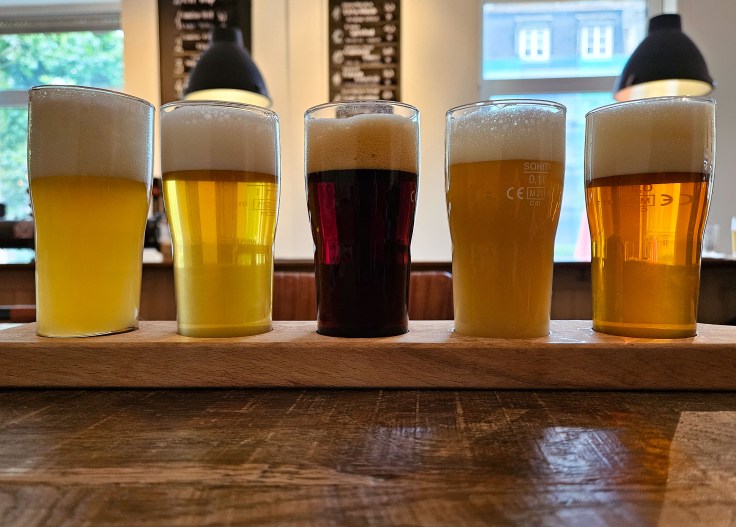
As it turns out the Camba tap house was a wonderful destination. They have 20 beers on tap, covering a mix of styles, serve very good Indian food, and the staff was welcoming and attentive, even to monolingual visitors like ourselves. We start by ordering a flight of five beers. The beers were pretty good, but in my opinion the hazy IPA from Berlin was substandard, out of balance with an unpleasant polyphenol bitterness from the hops. Day one lesson learned, when in Germany don’t order an IPA! On the other hand, the kellerbier from a Bavarian brewery (Bräuhaus Faust from Miltenberg) was a standout. As you will see in the next post that beer was a harbinger of things to come later in the trip. We follow that up with a couple of curries and full pours of the kellerbier. It was a good way to spend the evening and a rare meal on the trip that didn’t involve various permutations of pork, cheese, potatoes and/or fermented cabbage.
Strasbourg
A two hour train ride deposits us in Strasbourg on Sunday around lunchtime. We are staying in a flat, booked through Airbnb, on the seventh floor of a modern apartment building near the European Parliament. It’s clean and comfortable, with a balcony patio that offers a nice view of the city, and is conveniently located close to a tram stop. If you are visiting Strasbourg there are several airbnb options in this area to choose from.
France is divided up into administrative regions and the region of Alsace lies in the northeastern corner of the country. The Vosges mountains separate it from the rest of France and define the western border of the region. To the east, the Rhine River separates it from Germany. Over the course of the 20th century Alsace changed hands between France and Germany four different times. The culture here is a unique blend of French and German; croissants and pretzels vie for top billing, hearty sausages and foie gras can be found on the menus of many restaurants. This is one of the few parts of France where beer holds its own with wine. That’s not to say that wine isn’t prominent, white wines like Riesling and Gewürztraminer are the local specialities, but good beer is not hard to find. In fact, France’s best known beer, Kronenbourg 1664, originated in Strasbourg, but is now owned by Carlsberg and like many mass market lagers is brewed in many locations across the planet.
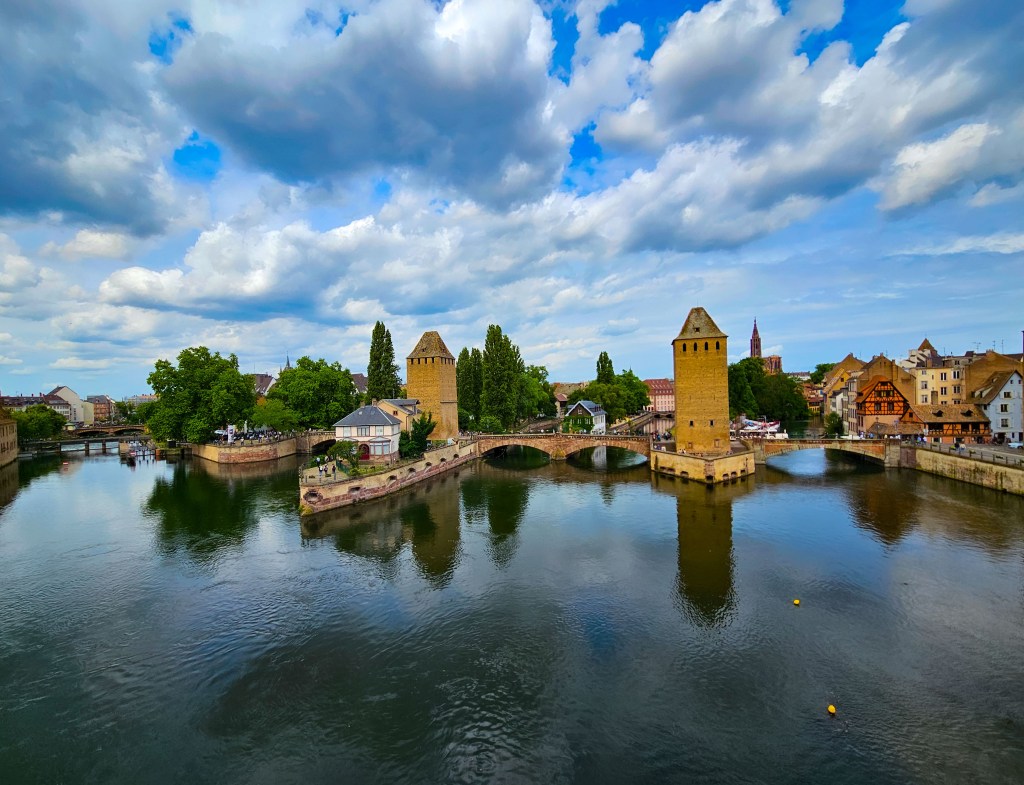
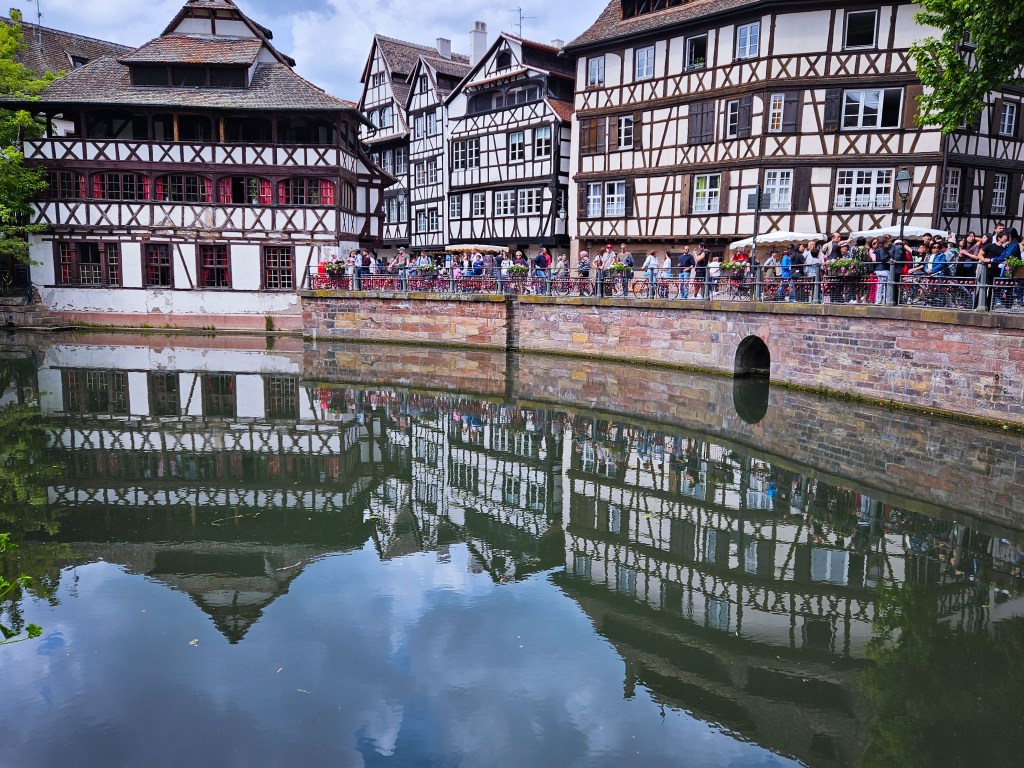
The old town is a charming mix of half-timbered houses and cobblestone pedestrian streets filled with bars, cafes and restaurants. It’s a designated UNESCO World Heritage site and walking around it’s easy to see why. It’s also a university town and home to the European Parliament, which gives it a an energy and vibe that save it from being too touristic. The gothic Notre Dame cathedral towers over the central square. It is one of the tallest cathedrals in the world, but curiously only one of the two spires that were envisioned for the church was completed. This gives it a kind of asymmetric look that is unusual. The Ill River splits into two forks at the Vauban Dam, encircling the old town. The district near the fork, called La Petite France, features a series of man made canals and pedestrian bridges that offer a myriad of opportunities to catch the half-timbered houses reflecting off of the mirror like surface of the canal. It’s old world charm compares favorably to any city in Europe.
Meteor Pils
For our first meal in Strasbourg, our destination is Brasserie Le Meteor. The brewery, which dates to 1640, claims to be the oldest in France and Meteor Pils, first introduced in 1927, is the O.G. of Alsatian Pilsners. La Meteor is located on the busy pedestrian street, La Rue 22 November, about halfway between the train station and the cathedral. The city is full of people enjoying the fine spring evening and upon arriving around 6 pm we are lucky to snag a small table in the outdoor patio that spills out into the street.
To a casual observer pilsner is a monolith, a generic term for a golden fizzy lager. To a brewer pilsner is something of a high art form. A vehicle for crisp, crackery malts and spicy, floral hops, each vying for dominance but in the best examples achieving a harmonious balance. A good pilsner is quaffable with a very clean fermentation character, but at the same time it shouldn’t be bland or soulless. The simplicity of pilsner means that small details like the water chemistry (soft or hard), the mashing procedure (infusion or decoction), and subtleties in the terroir of the malts and hops matter. As everyone reading this post will know the original pilsner hails from the town of Plzen in Bohemia (the modern day Czech Republic). It features very soft water, multistep decoction mashing, a yeast that leaves some malty sweetness behind, and the distinctive tang of Saaz hops. After it’s introduction in 1842, it inspired brewers across the globe to emulate the original pilsner we now call Pilsner Urquell. Nowadays brewers recognize Czech pilsners, German pilsners, Italian pilsners, and New Zealand pilsners as distinct or at least semi-distinct styles. Perhaps the least well known pilsner substyle is the Alsatian pilsner. It’s not something that you can just go pick up on the shelves of the local grocery store (or even the craft beer store) in middle America. So, let’s see what makes this style tick.
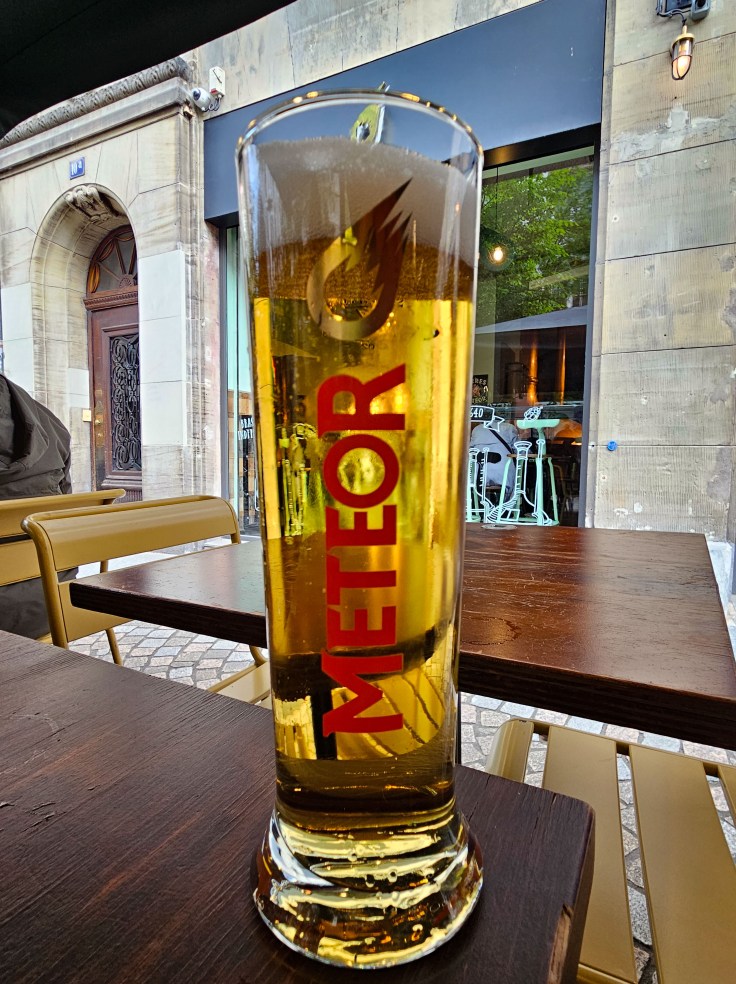
Meteor Pils is served in a tall cylindrical glass. It’s pale golden in color and crystal clear. The local hop variety, strisselspalt is the defining ingredient of an Alsatian pils. Since we are not far from the hop fields of Germany, it’s not surprising to learn that strisselspalt is very much in the vein of the classic noble hops, equal parts spicy and floral. As I savor my glass of Metor Pils, I have to say it’s an underrated hop. The other thing that sets it apart from its Central European cousins is the use of roughly 20% corn in the malt bill. That would definitely be a non-starter across the border in Germany. On the surface, the use of an adjunct grain might seem a sacrilege, but in practice it makes for a very quaffable beer. Meteor Pils is neither as dry as a German Pils nor as malty as a Czech Pilsner. With 26 IBU it registers as hoppier and less sweet than a classic American adjunct lager, like Coors Banquet Beer (10 IBUs). Meteor serves 8–10 beers at this location (my wife was impressed with the hefeweizen), but over the course of two visits I went back to the pils again and again.
Tarte Flambée
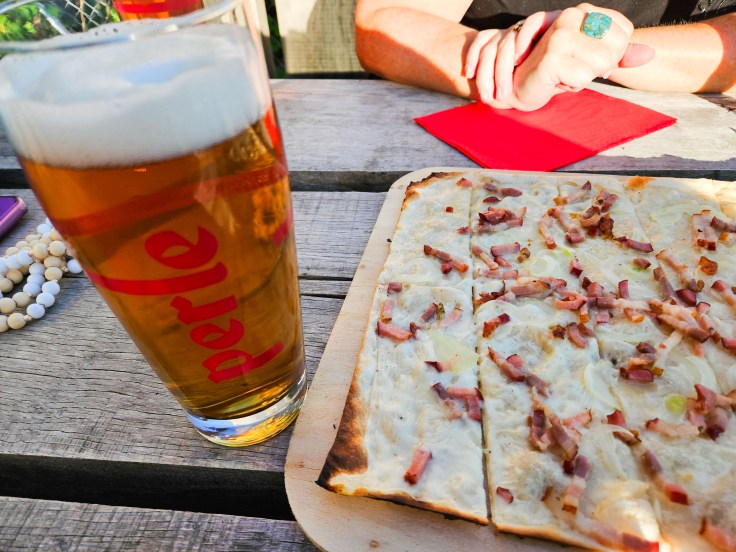
The other distinctive aspect of Alsatian beer culture is the tarte flambée (flammekueche in the local dialect). Just about every place that serves beer also makes a tarte flambée, and with good reason for the two are highly complementary. Tarte flambée is basically a pizza with a paper thin crust, cooked at high heat in a wood fired oven. The heat from the oven gives the crust a very crispy texture. The toppings are simple, white cheese (Munster cheese seemed to be the fromage of choice), onions, and small pieces of bacon are featured in the traditional version. Variations with thinly sliced potatoes or mushrooms are also common. The thin crust lends itself to folding each piece in half and eating it with your hands. An approach that is a culinary experience not unlike eating a quesadilla.
As many readers will know, my home town of Columbus, Ohio has its own style of thin crust pizza cut into squares. On the All Things Beer Podcast we did a deep dive on Columbus pizza with Jim Ellison, the world’s foremost expert on the topic (Episode 51 – All Things Pizza). In that episode Jim explained to us that the roots of Columbus pizza can be traced back to Chicago’s tavern-style pizza. (It turns out there are as many regional styles of pizza as there are styles of beer.) As Jim explained, tavern-style pizza was created to provide enough calories to keep people from leaving the bar to get dinner, but not so much as to fill them up and inhibit further beer drinking. Tarte flambée serves very much the same purpose. On our first visit to La Meteor we actually consumed two pies, a traditional one and a dessert-like one topped with thinly sliced apples and dusted in cinnamon. For the latter, the waiter poured some calvados (apple brandy) on the tarte flambée and lit it on fire. I’m guessing that’s what puts the flambée in tart flambée.
Perle Pils
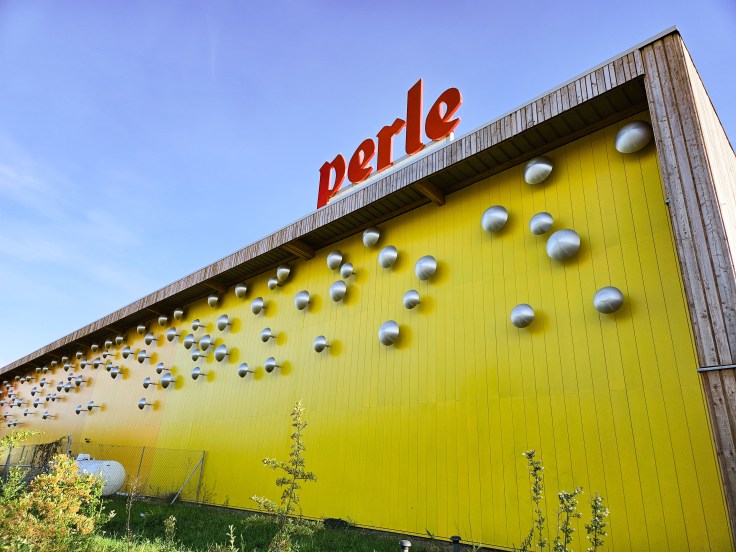
I had read about the medium-sized microbrewery Perle (4700 bbl annual production) in the Zymurgy article on Alsatian Pilsners. The history of the brewery dates to the 19th century, but the original brewery was solid in 1969 and closed in 1972. A descendent of the family that founded the brewery, Christian Artzner, restarted the brewery in 2009. Perle is located in a reasonably large industrial facility away from the center of town (10 place de l’Abattoir, F-67200 Strasbourg). The location is accessible by bus, which is easy to use with a tram/bus pass) and a short walk. They sell a range of beers, including IPAs, stouts, beers infused with herbs, etc. Since this is Alsace they also serve up a range of tarte flambées. Compared to Meteor Pils, Perle Pils is a little stronger (5.4% abv vs 5.0% abv) and a little more bitter (35 IBU vs 26 IBU). They don’t use corn in the malt bill, but instead add a bit of Munich malt, which makes the beer a little darker and maltier to the palate. The higher hopping rate allows the whole cone Strisselspalt hops to come through, which is a welcome tweak. Though I would say the beer doesn’t come across as crisp as the Meteor Pils. The taproom at Perle is a handsome space with a modern look to it. There is a reasonably large beer garden on the side of the building. The views aren’t spectacular here, but the space is pleasant and relaxing.
Beyond Pilsner
Pilsners don’t dominate the beer scene in Strasbourg like they do in Prague or Plzen. We did make a few stops at places where other beer styles were center stage. I mention a couple of places we visited here for the benefit of those looking for something different while visiting Strasbourg.
Brasserie de la Lanterne – This small microbrewery is a good choice if you get thirsty while walking around in the old city. It’s tucked away on a small side street of the same name (5 Lantern street, 67000 Strasbourg) not too far from the cathedral. In fact, we visited on a busy holiday (Ascension Day) afternoon after visiting the cathedral. I had the blonde and my wife a session beer with cucumbers, both were pretty decent. If you get an outside table (space is somewhat limited) it’s a good place for people watching.
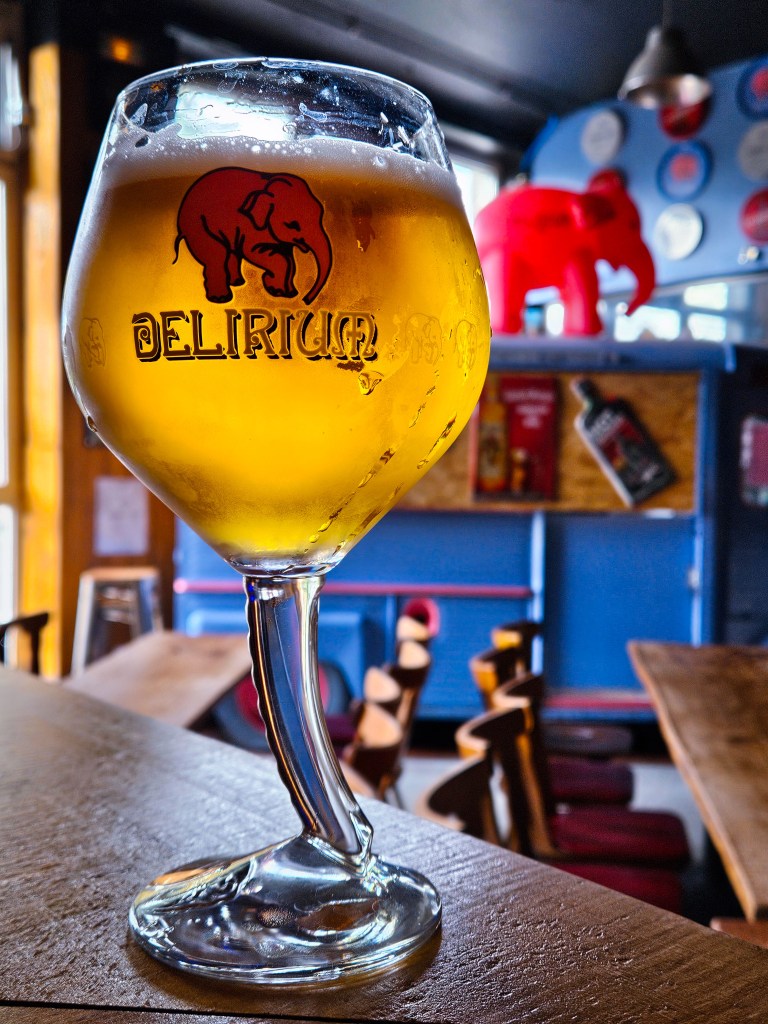
Delerium Café – There is an outpost of the iconic Brussels institution in Strasbourg. It’s located on the north fork of the Ill River (5 Quai de Paris, 67000 Strasbourg) not far from the central train station. The bar is on the second floor of a building with relatively few windows, so once inside the location isn’t terribly relevant. The inside is spacious and dimly lit, with one bar for beer and another for cocktails. The walls are adorned with Belgian beer signs and other breweriana. There are some nooks where you can get a social media pic with the Delirium pink elephant in the background. The bar doesn’t open until 5 pm and it stays open until late in the night. There’s a dance floor at the end furthest from the windows and a DJ comes on at 10 pm. I get the sense that this is a place frequented by young people going out for a night at the club. However, we did not stick around long enough to find out.
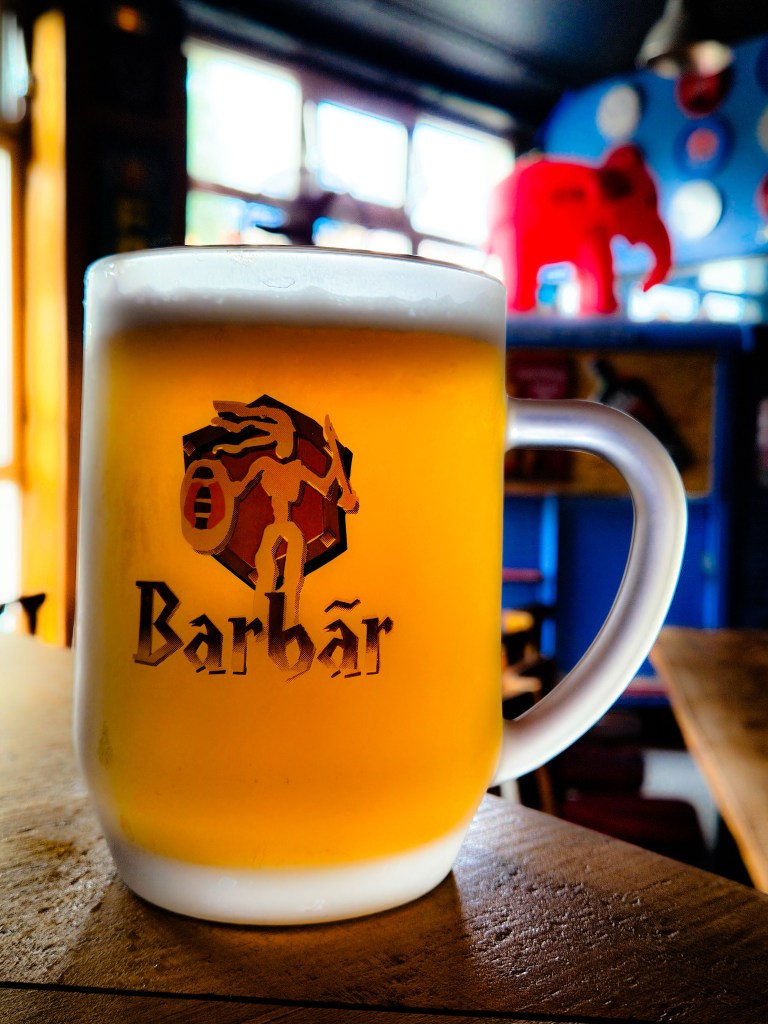
As expected they have an extensive list of Belgian beers on draft and many more in the bottle. Upon ordering I find out that it’s happy hour (5–8 pm?) and 500 mL pours are the same price as 250 mL pours. Keen to try something new, I order a beer I’ve read about in Michael Jackson’s book on Belgian beers, Barbar by Brasserie Lefebvre. It’s a blonde ale, made with barley, wheat and Belgian honey. It goes down dangerously smooth for a beer that clocks in at 8% abv. Before too long the glass is empty and it’s time to decide if we should get another round. At the risk of stating the obvious, sculling half-liter pours of beers this strong can get you in trouble. Despite the hazards, the answer is obviously yes. For the second beer I go for the classic, Delerium Tremens in the fanciful bespoke glassware. This one is even more potent, 8.5%, with a little more bite. After two beers we move on. I daresay that one more would have put me over the edge.
Beyond Strasbourg
On our last day in Alsace, we ventured out of Strasbourg. The plan was to travel to Freiburg, Germany by train and pick up a rental car for the rest of the trip. It turns out that when renting and returning a car in different places, it’s much cheaper if both of those places are in the same country. Since our trip was ending in Munich, the price for renting a car for 12 days dropped from over €1000 if we picked it up in France to less that €600 if we picked it up in Germany. It was a logical plan, but things quickly went awry when we realized that we’d left our passports back in the apartment. So we detrained in Offenburg, Germany and walked to the Europcar office to figure out our options. The good news was that we could pick up a car in Offenburg rather than the more distant Freiburg. The bad news was that a passport was a non-negotiable requirement for renting a car. This triggered a series of train and tram rides (fortuitously the Strasbourg tram goes across the Rhine into Germany) to retrieve our passports. Four hours and €23 later we were able to pick up our rental car. A compact, azure blue Audi with a standard transmission.
Automobile secured we scrapped our plans to visit Freiburg and headed for Colmar, a town of roughly 67,000 residents located in the heart of Alsatian wine country. We arrive around 5 pm to find the charming old town bustling with people on a gorgeous Friday evening. Hungry and thirsty we opt for another Belgian outpost, snagging a seat on the patio at Café Jupiler. Given the unseasonably warm weather, the temperature was hovering near 80 °F, a glass of Hoegaarden sounded appealing. Paired with a puff pastry filled with ham and cheese (both staples of Alsatian cuisine), it did not disappoint.
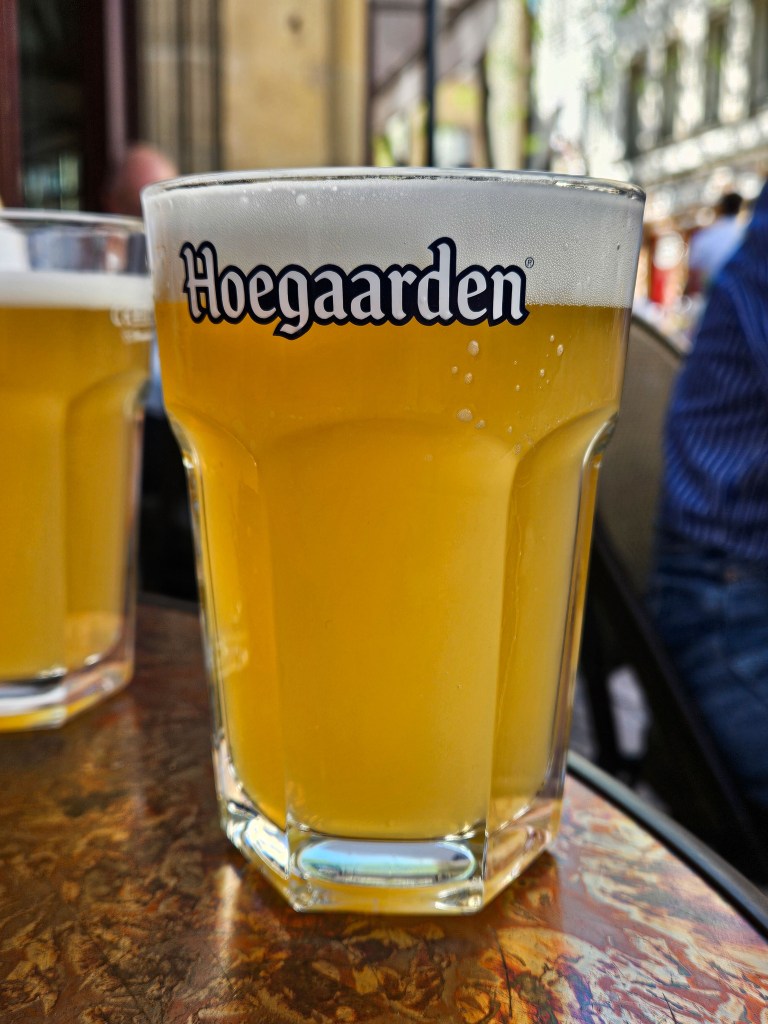

Upon leaving Colmar we drove up into the Vosges Mountains to a town called Keysersberg. As the day stretched into evening we drove through the vineyards that cover the lower slopes of the Vosges. The countryside here is the definition of bucolic. Keysersberg is a village straight out of a fairy tale. The ruins of an old castle that once guarded the mountain pass sit on a mountainside above the town. A small river cascades down the mountain and through the village. A stork surveys his surroundings from a large nest atop the spire of the village church. The people are in good spirits as the magic hour approaches on what is a four day weekend for many. (Much later on when writing this blog post I learn that Keysersberg is also the place where Anthony Bourdain took his life. Maybe this fairy tale is more of the Brothers Grimm variety.)
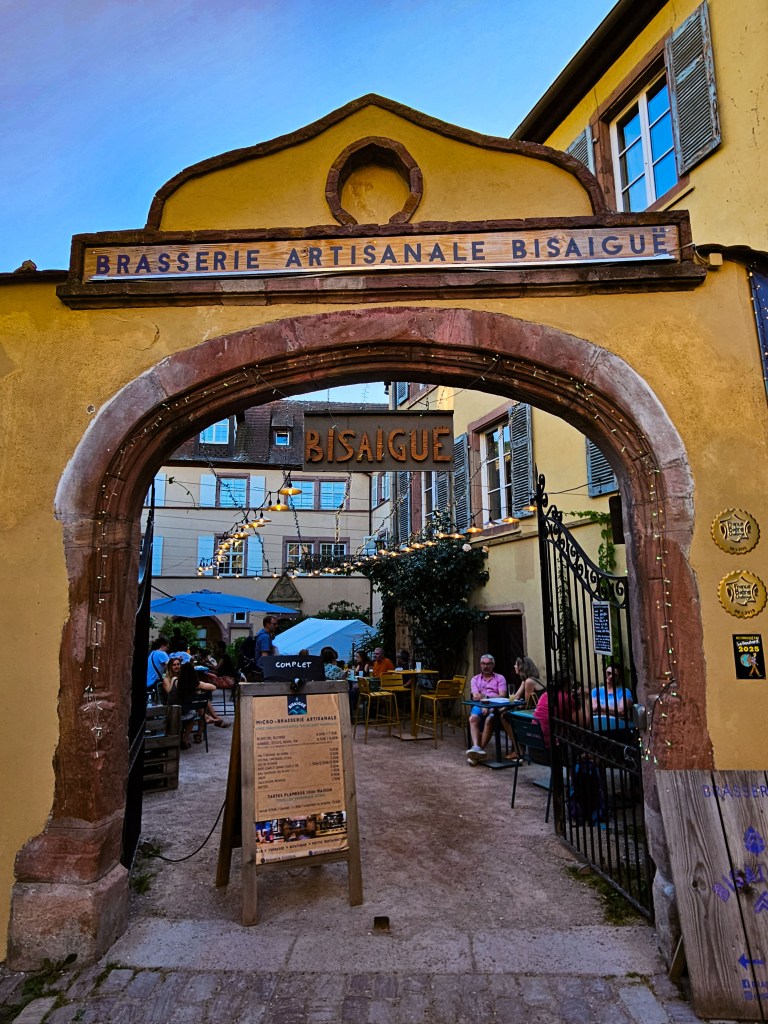
Our destination is Brasserie Artisinal Bisaigue, a charming microbrewery tucked away up here in the heart of wine country. After parking down by the church, we make our way up the winding cobblestone streets to the brewery. There’s a cozy taproom located below street level, with exposed brick walls, a cobblestone floor, and a small bar. There is also an outdoor terrace part that is popular tonight. The beer selection is characteristic of a European craft brewery: IPAs, milk stouts and the like, along with some more traditional offerings. The newest release is a black IPA dedicated to Kobe Bryant. I probably should have stuck to one of the flagship beers, blonde or blanc, but I’m seduced by the cold IPA. It was a decent beer, but coming from the land of IPAs it doesn’t quite live up to my expectations. Once again I’m reminded to stick to the local specialties when traveling. I will say the ambience here is hard to beat.

 Pat's Pints
I can imagine that was a surprise. A pitcher of wine consu.ed solo would do some damage. From what I’ve heard apfelwein is something of an acquired taste. Would you agree?
when I was 20, I hitchhiked thru Europe and when in Frankfort I thought I was ordering a pitcher of beer, but it was a pitcher of apple wine. Big mistake.