In the last post we explored Strasbourg and the local beer style, Alsatian pilsner. Think of that as an appetizer, an opening act if you will, because our next destination is Bavaria, the land of lagers. Our first stop is Bamberg, a city in Upper Franconia best known for its smoky Rauchbier, but as I found out Bamberg has so much more to offer.
The journey from Strasbourg by car involved a stop at the medieval walled city of Rothenburg ob der Tauber. It is a wonderful old city on Germany’s Romantic Road route, but its charm is somewhat diminished by the horde of tourists who descend upon the city every day. We stopped for lunch near the old town square and viewed the marvellous wood carvings in St. Jakobs church before continuing our journey.
Like Rothenburg, Bamberg is a very old city. It’s well over 1000 years old and was largely spared the destruction of allied bombing raids in WWII. Unlike Rothenburg, Bamberg’s past and present is steeped in beer. It was in this part of Germany that brewers first started aging their beer in underground caves, a practice that would come to be known as lagering. The first brewery in Bamberg was established at St. Michael’s, a Benedictine Monastery, in 1122. Bamberg imposed a beer purity law very similar to the Reinheitsgebot in 1489, twenty seven years before the better known Bavarian decree. Bamberg is the only city I know of where maltsters still routinely kiln their malts over a wood burning fire, a practice that imparts a smoky character to the beer and was the norm centuries ago. In this town of 80,000 residents there are no fewer than nine privately owned breweries, two of which (Klosterbräu and Spezial) date back to the 16th century. A visit to Bamberg is like a visit to a thriving, interactive museum of beer, or at least the lager wing of that museum.
Later in this trip we’ll visit Munich, a city rightfully known as a mecca for lager lovers. Some of you might be wondering how the beer cultures in Bamberg and Munich differ from one another. While both cities share a love of lagers and leafy beer gardens, they differ in many important ways. The variety of beer styles on offer in Bamberg exceeds that in Munich. Everywhere in Munich serves a helles, and nearly everywhere you can also find dunkel and a weizen. Depending on the season you might be able to get a bock/doppelbock or a festbier/märzen, but in many places the selection doesn’t extend beyond that. You can find all of those styles in Bamberg as well, but there are also rustic kellerbiers, old-time brown beers, deep black schwartzbiers, hoppy pilsners, and of course the local favorite, rauchbier. Munich is dominated by large breweries, breweries that export their beer across the world. Bamberg is largely home to smaller breweries, many that have minimal distribution outside of the city (Schlenkerla being the obvious exception). Both are fantastic destinations for a beer lover, but very different places.
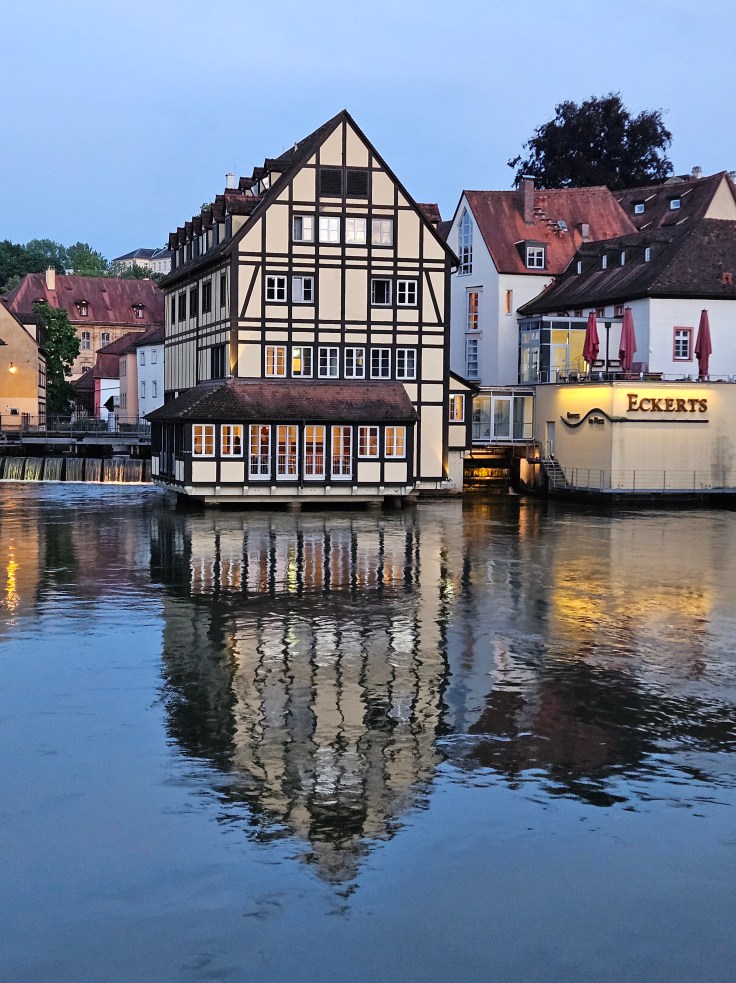
We arrive in Bamberg at 5:30 pm on Saturday evening in early June. The city is hopping with lots of people out enjoying the warm weather. We are pleased to find that our hotel (Hotel Nepomuk) is located in a beautiful spot, much of it built right over the Regnitz river. Not only is the location fantastic, it’s a destination in its own right (even if you don’t stay here they have a fine restaurant with a good beer selection if you want to take a meal here). From our hotel room we can look downstream and see Bamberg’s signature landmark, the Altes Rathaus (Old Town Hall). The 600+ year old building is built on a man-made island in the middle of the river. Apparently the bishops who ruled Bamberg in the middle ages wouldn’t concede any property for the town hall, so the citizens decided to put it in the middle of the fast flowing river. A half-timbered portion of the building seems to hang over the Regnitz on the upstream side. It reminds me of the prow of a great ship cutting through the water. I’ve travelled a lot and I don’t think I’ve seen anything quite like the Altes Rathaus.

Spezial Keller
Once we get settled in the hotel and the car is deposited in an underground parking garage, it’s high time to join the fun. Like Rome, Bamberg is built on seven hills and for centuries the breweries here have been lagering their beer in caves dug into these hills. Some of the oldest caves were once sandstone quarries. At some point in the now distant past, someone realized it made sense to set up a beer garden near the lagering caves to serve beer to the masses. So, in this part of Germany beer gardens are called kellers (the literal translation is cellars). What better place to enjoy a local lager on a warm Saturday evening than in a keller on a hill overlooking the city. So we head back up the steep Stephansberg Hill, retracing the route from whence we entered the town, this time on foot.
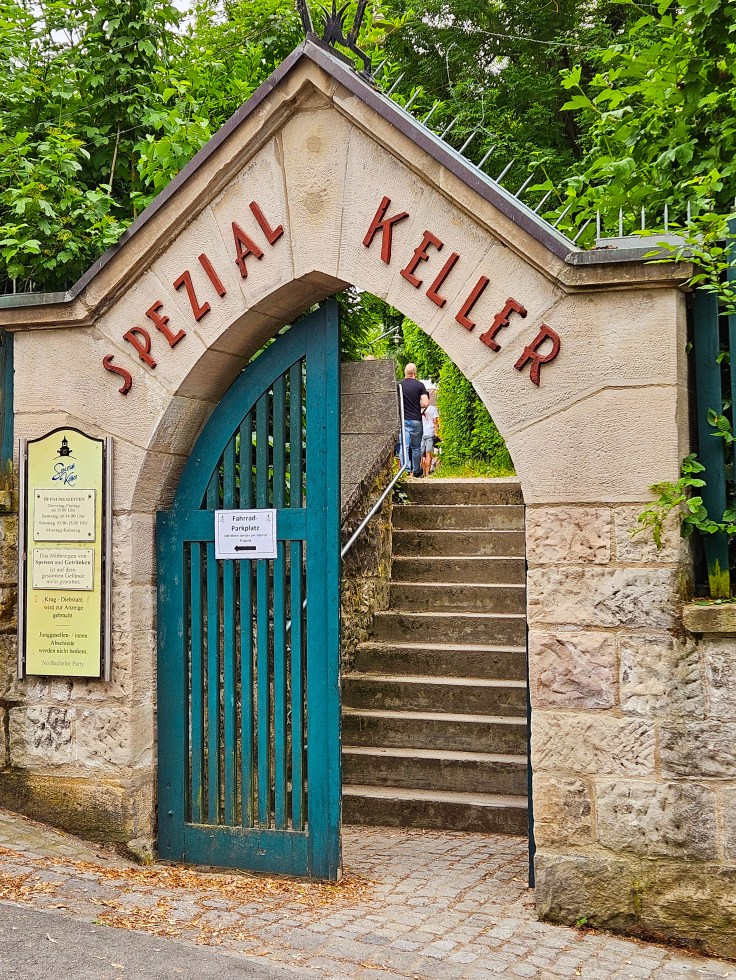
The first stop on our Bamberg beer tour is the Spezial Keller, by many accounts the premier beer garden in the city. To get there you go past the Schlenkerla production facility (Heller Bräu Trum Schlenkerla). For centuries Schlenkerla has matured their beer in the old lagering caves here. Until the 1930s beer was brewed at the tavern and then brought up here to lager, but as the brewery grew it made sense to both brew and lager on Stephansberg Hill. Unfortunately, it’s not normally open for visitors, so we keep going until we get to the Spezial Keller. We aren’t the only ones with this destination in mind, so finding a place to sit is no easy task. Eventually sit down at a table under a large tent next to the smallish building that holds the kitchen and a cozy beer hall. We end up sharing the table with two groups of Germans, both married couples about our age.
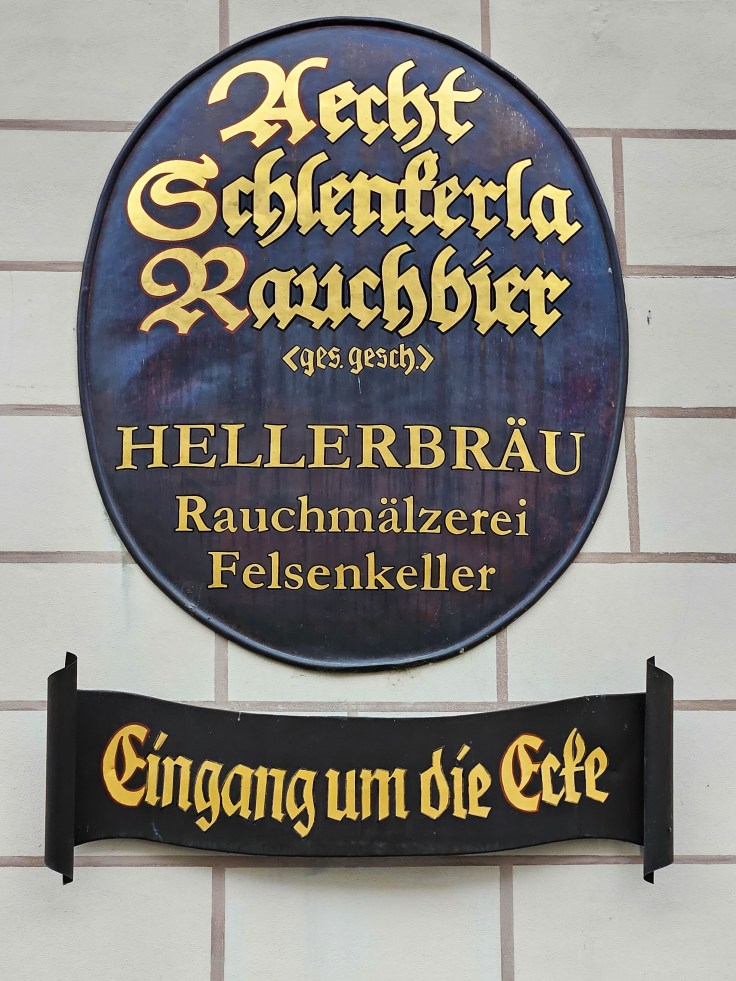
Bamberg is best known for rauchbier, but only two breweries specialize in this polarizing style – Schlenkerla and Spezial. One of our new friends at the table, a woman from a town near Stuttgart tells us that rauchbier is an abomination, one of the few German beers that she considers a drain pour. Of course, she is drinking a soda, so I don’t know how much I should trust her opinion. Despite the warning my first Bamberg beer is the Spezial Rauchbier, which the menu simply refers to as “lager.” Served in a half-liter dimpled glass mug, it’s crystal clear and deep amber in color. Initially the smokiness is quite strong and the first few sips bring to mind a slice of smoked ham served on freshly baked bread. About one-third of the way through the beer my palate adapts and the underlying bready malts start to shine. By the end of the glass the smoky flavors have transitioned from a yelling in my face to a background conversation.
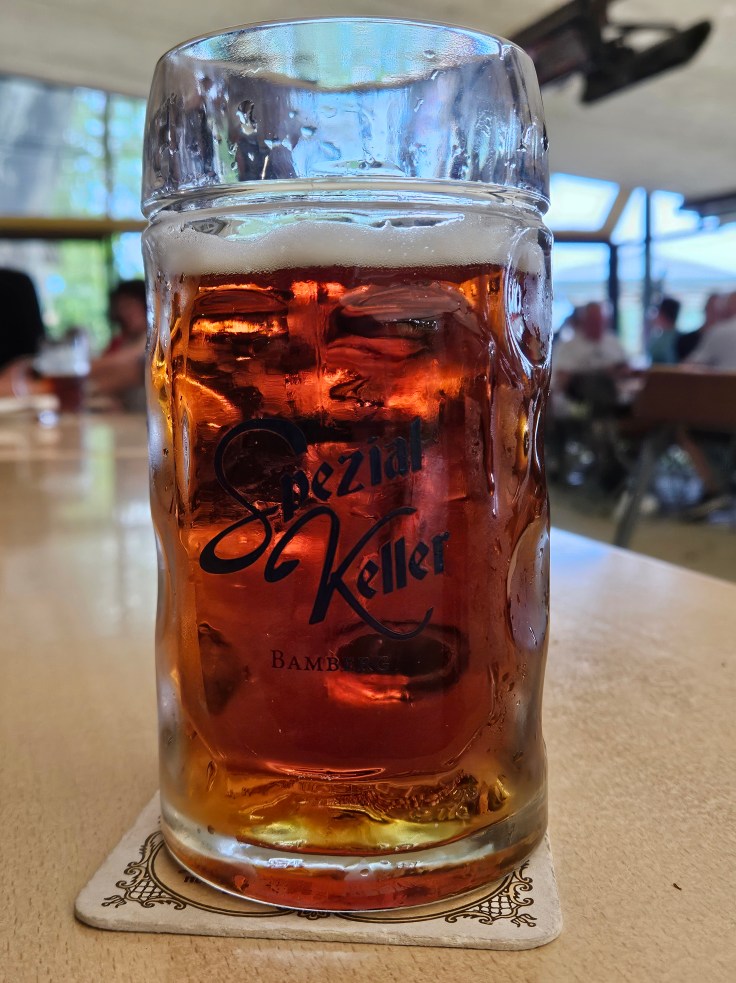
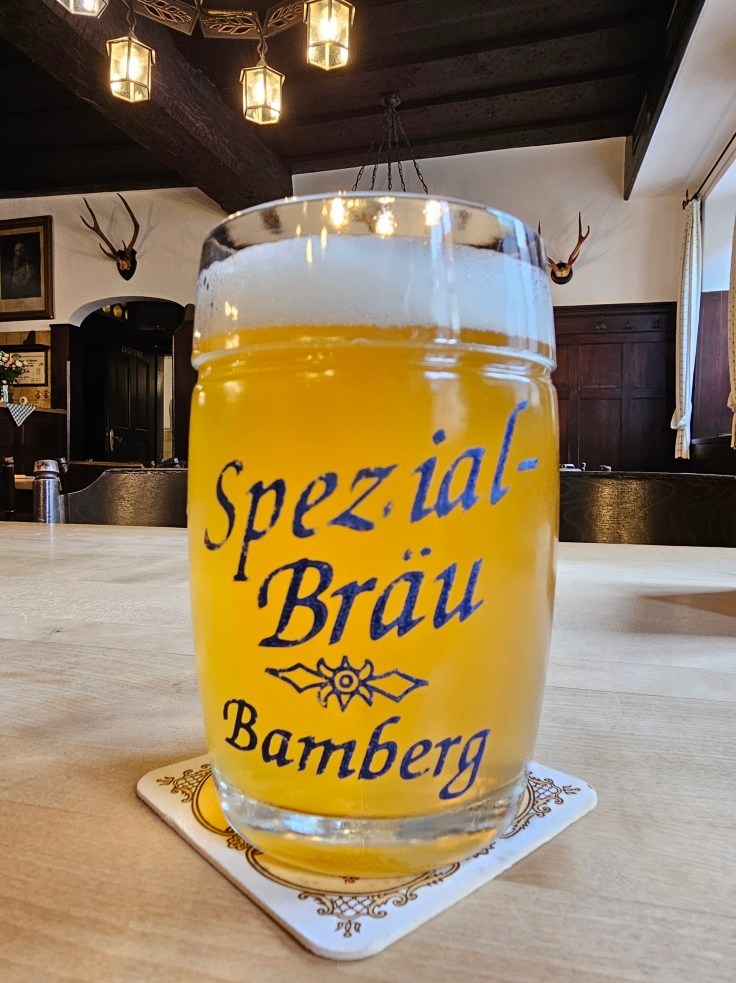
The Rauchbier lager goes down pretty easy and before long it’s time to order another beer. For the second round I order the Ungespundetes, a substyle only made around Bamberg. Ungespundetes translates as unbunged, it’s not an easy word to pronounce so feel free to call it a U-beer. As I understand it U-beers are unfiltered beers closely related to a kellerbier, but for a portion of the fermentation the bung is taken out of the cask leading to a lower carbonation level. (Remember that to follow the Rienheitsgebot German beers are naturally carbonated, not force carbonated.) This one is not smoky (or should I say only inflected with a wee bit of second hand smoke) and hazy to the point of being translucent, as you can see in the picture. The malt character is bready but it doesn’t seem cloying even as you empty the mug. There is a subtle fruity note that comes from either the hops or the yeast or maybe both. Maybe it’s the moment, but it just seems to embody freshness. This is a beer for people who love beer!
Around the time I start in on the U-bier, it starts to rain lightly and our new friends tell us that heavier rains will be coming soon. Suddenly the people sitting at the tables that spread across the hillside are looking for tables in the covered area where we are sitting. I guess you could say the tables have turned. As it turns out the heavy rains never do arrive and after two beers we bid our new friends auf wiedersehen and head back down the hill.
Aecht Schlenkerla
Even though I know its going to be busy, I feel it’s high time we visit Bamberg’s most famous brewery, Aecht Schlenkerla. The iconic tavern has been a pub and a brewery since the 15th century. It’s a half-timbered building in the heart of the old town, called the Sandstrasse quarter. This part of town lies between the river and the hill upon which the cathedral is built. The streets are pedestrian only and the businesses a continuous block of three story, half-timbered store fronts, one of which serves one of the world’s most famous beers. Inside the old tavern is divided up into a series of cozy rooms. I’m sure on a Sunday evening in January it’s a right proper place to have a pint at a communal table in a room heated by a wood burning stove. In such a setting one might imagine what it would have been like to travel the countryside on horseback staying at taverns that provide a warm meal, a mug or two of beer, and a place to sleep for the night. On a Saturday evening in early June the old tavern is nowhere near big enough to hold the party going on in the streets of the old town. Men dressed up as night watchman and carrying halberds walk by and pose for pictures with people in the streets. Groups of men in town for a stag party walk by drinking beers and singing songs. Tourists, most of whom are speaking German, walk by and snap photos in the fading light. On a night like tonight the indoor seating is reserved for those who are dining. Even if we were amenable to a second dinner, it’s doubtful we could get a table at this hour.
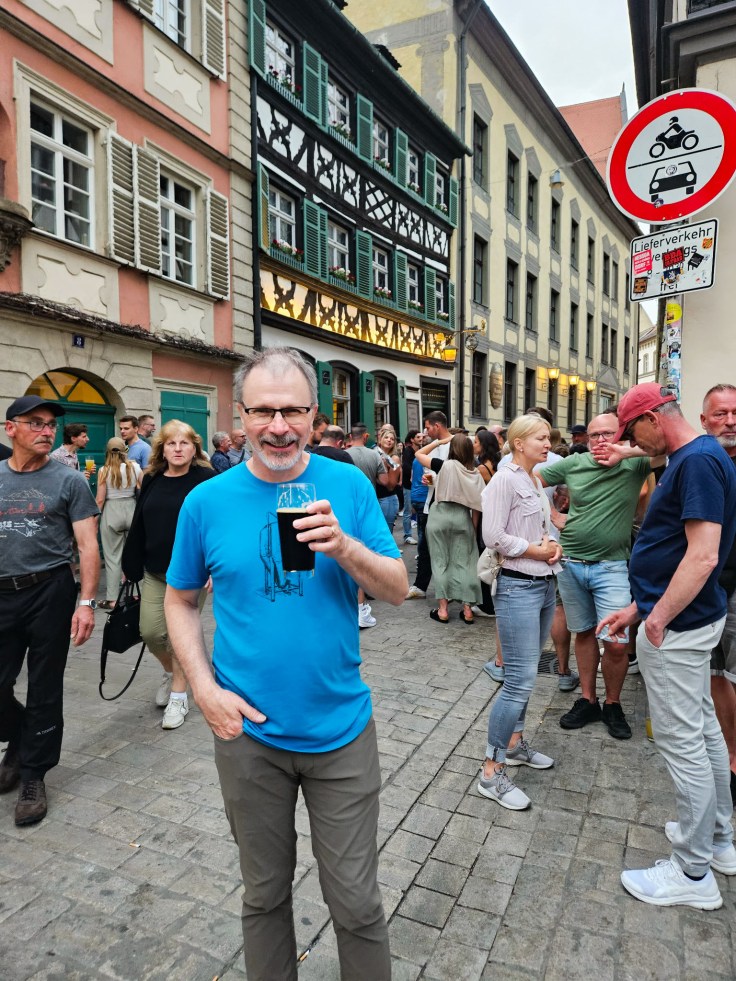
Fortunately, all is not lost. You can walk up to a small window in the corridor between the main hall of the tavern and the small interior beer garden and get a glass of their flagship Rauchbier Märzen. I later learn the Germans call this a schwemme. The last time I encountered this system was on a visit to the French Quarter in New Orleans many moons ago. However, this being a historic German brewery they don’t serve the beer in a disposable plastic cup (can you imagine the scandal!), instead you get an unadorned willibecher glass for a deposit of €2. When you take the beer away you get a red plastic token embossed with the Schlenkerla logo, and when you bring the glass and token back they return your deposit.
With a glass of the iconic elixir in hand I retreat into the street and savor it with dozens of other people who have done the same. My wife Laurinda is not one of those people, she doesn’t want anything to do with this beer. One notable thing about getting the Schlenkerla Märzen at the source is that they pour the beer on gravity dispense from a wooden barrel. This is basically the German equivalent of English cask ale. This leads to a lower carbonation level, which results in a softer mouthfeel that allows the malt character to come through more clearly. Compared to the Spezial Lager, the Schlenkerla is darker, the malts more toasty, the finish a little more bitter, and perhaps because of all of this the smoke seems more intense. For what it’s worth I would probably lean toward the Spezial, but I’m sure others would disagree. Either way, when in Bamberg you have to pay a visit to Schlenkerla.

Klosterbräu
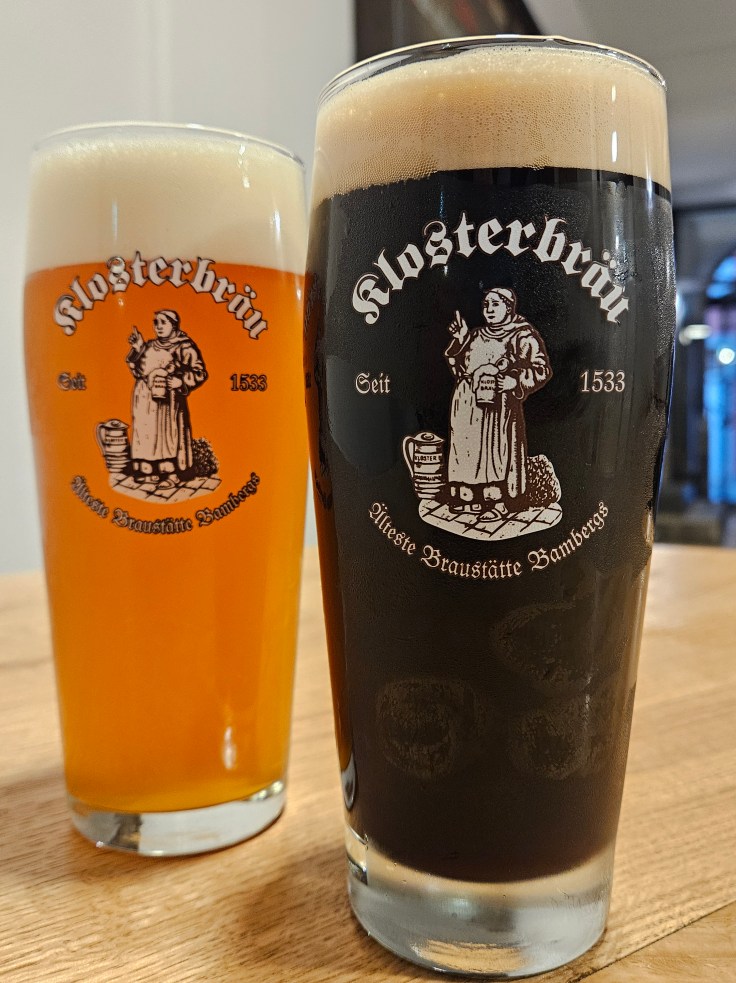
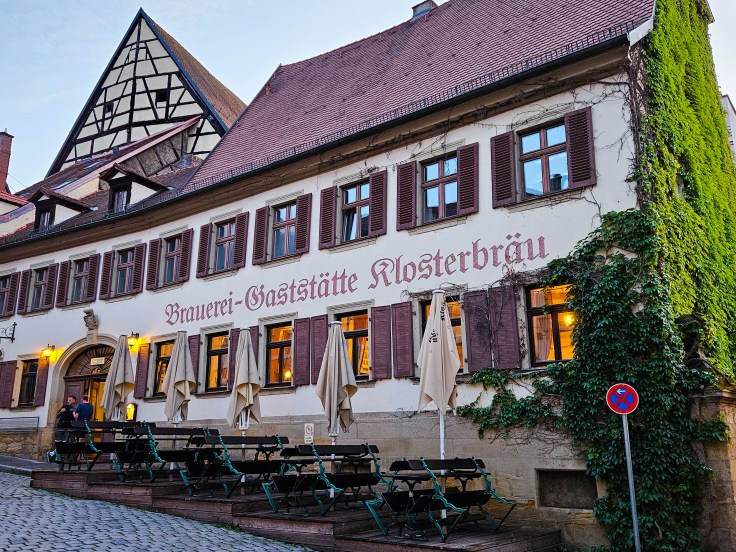
By now twilight has turned to turned to darkness and the rain has returned so we decide to head back to the hotel. Fortuitously, the oldest brewery in Bamberg, Klosterbräu (est. 1533) is located next door to our hotel. It seems a pity to turn our back on such good fortune, so we stop in for a final beer of the night. Like Schlenkerla the inside seating in the historic pub is for those who are dining in. Everyone else orders their beer from a window that opens into the bar (the schwemme). There are four beers on the menu – braunbier (brown beer), schwärzla (black beer), kellerbier, and rauchbier. I get the schwartzbier and Laurinda the kellerbier. No one is drinking in the street here, but you can either head into a small inner courtyard or find a spot at one of the tables in front of the brewery. We chose the latter and take a seat at a table with a large umbrella next to a German couple visiting for the weekend. The schwartzbier is excellent, restrained roastiness and dark chocolate accents blend harmoniously with the rich malt backbone. There’s even a hint of creaminess to the mouthfeel. I later learn that they’ve been brewing this beer for over 500 years, so it might be one of the oldest surviving examples of the style!
I’ve now hit the two liter mark for the evening and while I’m tempted to stay for another, we do the wise thing and retire to our room. I’m going to end the post here, but keep an eye out for a follow up post where I describe our Bamberg experiences over the next two days. Of course we’ll visit more breweries, but also touch on some non-beer sites, enjoy a couple of hearty Franconian dinners and go on a beer hike in the countryside.
 Pat's Pints
Nice article Pat. Thanks for sharing your experiences.
Thanks Bill. I hope you are well.