I’m currently in the middle of a 3 month stay in Japan. It’s an incredible opportunity, so I’ve doing my best to explore all that Japan has to offer. Naturally that includes checking out local breweries and other beery spots of interest when the opportunity presents itself. In my last post I made some general observations about the beer scene in Japan. In this post and an undetermined number to follow, I’ll be sharing experiences from my trip and suggesting some possible itineraries for future travelers. In doing so I’m cognizant of the fact that you probably didn’t travel all the way here just for beer, so these itineraries will include worthwhile diversions to interject a little history, culture, dining, and/or shopping into your experience. The narrative that follows is by no means authoritative or exhaustive, so it would be much appreciated if you would take time to leave a comment. With that disclaimer out of the way let’s discuss the first of three different itineraries for a day out in Tokyo. Note that the images that come at the end of each section are shown in slide show mode, so you will have to scroll to see them all.
Tokyo is a massive city, but like any metropolis it’s made up of smaller neighborhoods, and the neighborhoods of Tokyo offer wildly contrasting experiences. Shibuya is filled with skyscrapers and neon displays. It’s crowded and filled with shopping outlets that cater to high-end customers and young shoppers (and make no mistake Japanese youth are a very fashionable group). Shinjuku is bustling and chaotic, home to one of the world’s busiest train stations, similar in some ways to Shibuya but with a seedy edge, particularly as you move north of the station. Ginza is all about luxury, elegance, and architectural flair. Akihabara is a shock to the senses – anime, manga, pachinko parlors, and maid cafés are all on full display here. If you are closer to 60 than 20 it might not be your cup of tea. Asakusa is home to Tokyo’s grandest shrine and one of the relatively few places in Tokyo to get a feel for the traditional side of Japan (though the best places to experience traditional Japan are not located in Tokyo). During the Edo period (1600–1870) it was filled with geisha houses, kabuki theaters, and brothels, so you could call it the OG of Tokyo entertainment districts. Each of these neighborhoods has its own appeal, but we are going to start in Ueno, home to the city’s oldest public park, a large railway station, and a sprawling market. Ueno may offer the best mix of culture, history, shopping, and night life that Tokyo has to offer. Given the extensive rail connections, it also makes for a good home base while staying in Tokyo.
Ueno is easily accessible by train from almost anywhere in Japan. You can reach Ueno Station in 15 minutes from Tokyo Station or just under an hour from Narita International Airport. If you are traveling from the northeastern parts of Honshu it will likely be your first entry point into Tokyo. The most notable feature of the neighborhood is Ueno Park, an expansive green space that covers 130+ acres and is home to six museums, four shrines/temples, Tokyo’s zoo, and a very large pond (mostly) filled with lotus plants. Southeast of the park, the sprawling Ameyoko Market fills the streets between the Ueno and Okachimachi stations. After the end of WWII this market was where vendors sold black market items that locals acquired from the occupying American army. This is still a place where you can get bargain fashions, souvenirs, fresh seafood, or food items ranging from fruit to fish served on a stick.
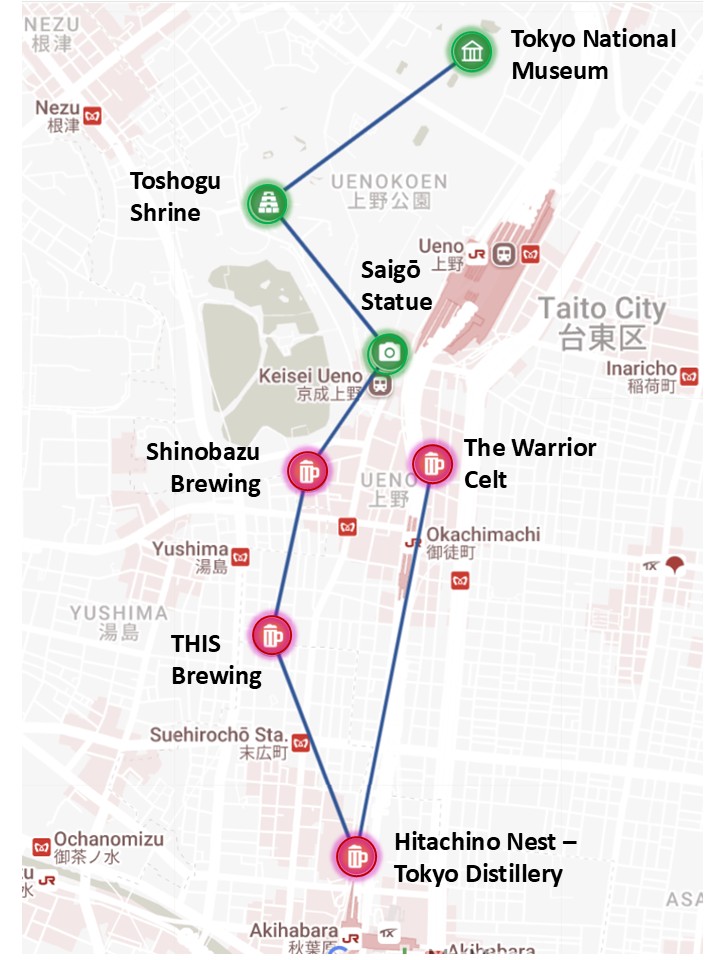
Ueno Park
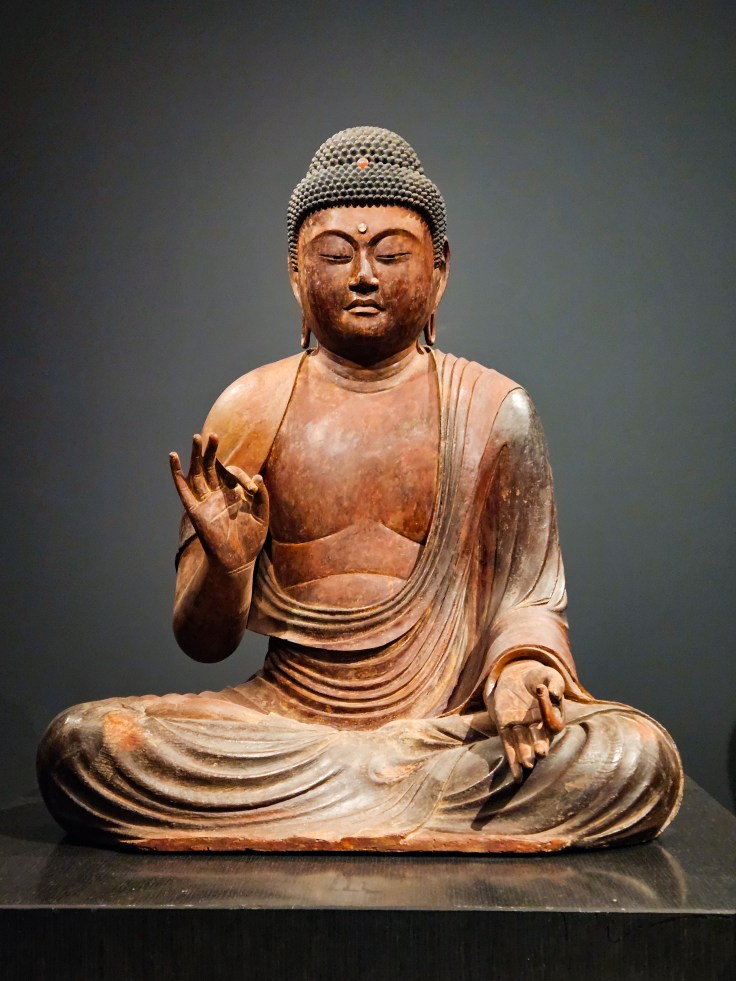
Most of the breweries and bars on our itinerary don’t open until the afternoon or evening (check the opening hours when planning your day), so we’re going start at the Tokyo National Museum, home to one of the world’s largest collections of Asian art (admission ¥1000). Since we are in Japan it seems appropriate to start at a museum which contains many things you won’t find in a western museum—temple statues, Japanese swords, elaborate kimonos, woodblock prints, Noh and Kabuki masks, as well as art from other parts of Asia. You could spend most of the day here, but for me a couple of hours is sufficient. If you’re interested in something different you could instead visit the Museum of Western Art, the Royal Museum, the Museum of Nature and Science, the Metropolitan Museum of Art, or the zoo, all of which are also located in Ueno Park.
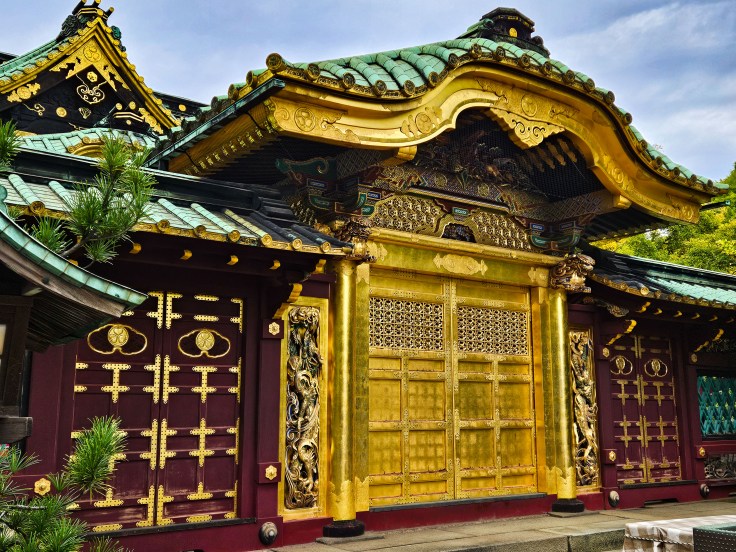
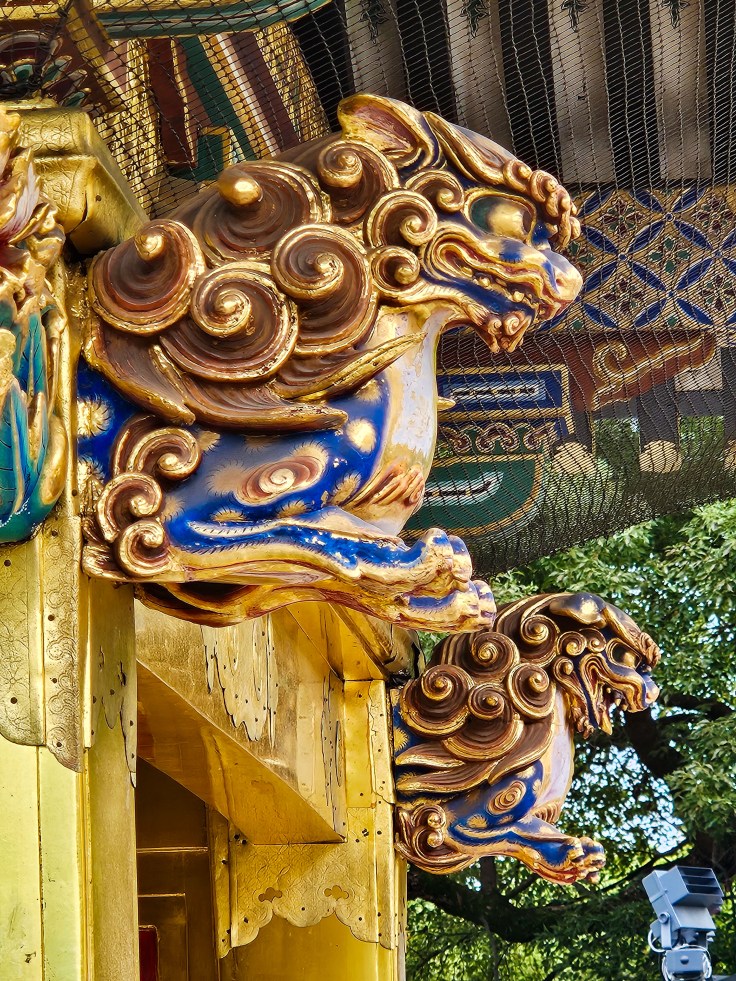
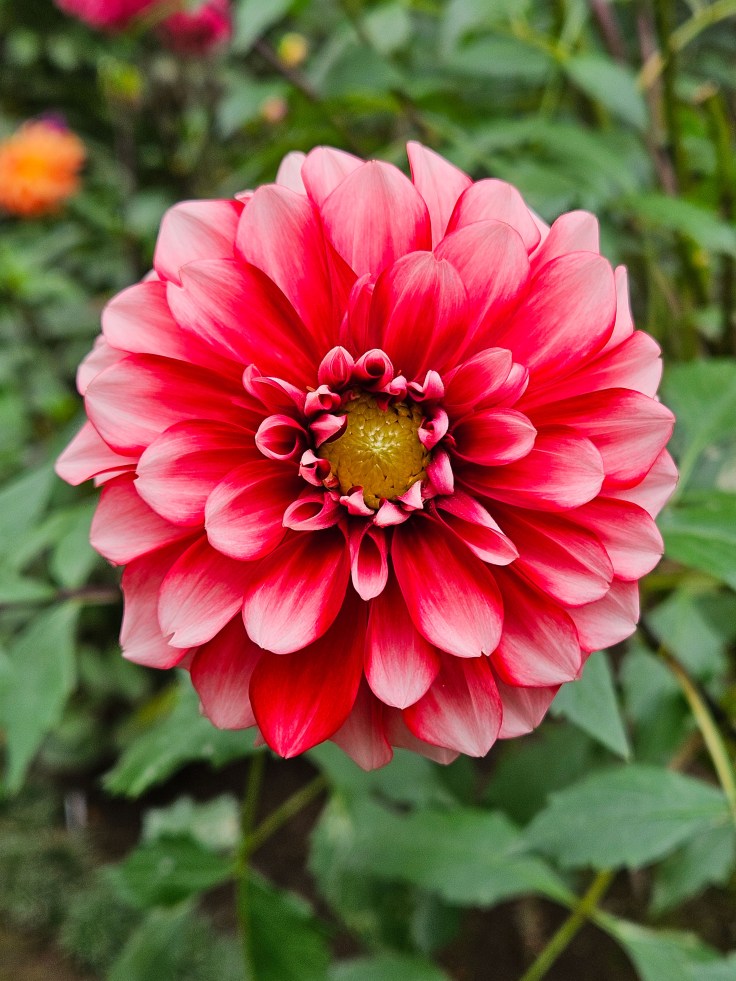
Few city parks have a history that can compare with Ueno Park, so upon leaving the museum I recommend taking in a few sights around the park. Japanese history afficionados will know that Tokyo, then Edo, effectively became the center of power in 1603 when Ieyasu Tokogawa became Shogun. His reign began a 265-year period when the Tokugawa line ruled over a largely peaceful Japan that was effectively isolated from the outside world. The Ueno Toshogu Shrine was built in 1627 to commemorate and enshrine Ieyasu’s spirit. It was located within the sprawling Bhuddist temple complex, Kan’ei-ji, which was built to ward off evil spirits that might seek to enter the city from the northeast. It seems that in the old days evil spirits were required to enter a city from the northeast. Nowadays they seem to come from everywhere. Anyway, the Toshogu Shrine still exists and unlike many things in Tokyo it has been spared the ravages of earthquakes, fires, and allied bombing raids. The shrine is smaller than many in Japan, but very elegant. Much of the main shrine building is covered in gold leaf. For ¥700 (about $5) you can enter the inner courtyard and see the intricate detail of the shrine and the equally impressive carvings on the wall and gate that surround the main shrine. I’d say it’s worth the price of admission, and unlike the Tokyo National Museum a visit here doesn’t take up too much time. For an additional ¥800 you can visit the peony and dahlia garden, if the flowers are in bloom. When I visited in early November the dahlias were spectacular.
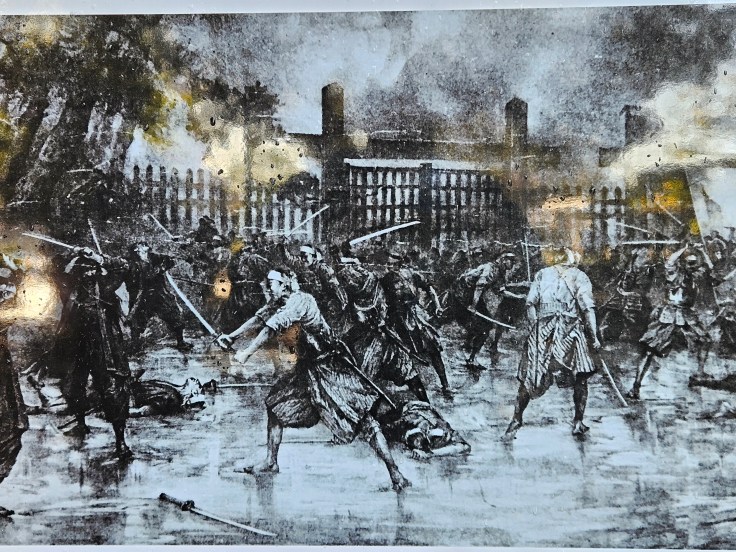
Ueno Park also played a prominent role in the events surrounding the last days of the Tokugawa Shogunate. In the 1860’s Japan became embroiled in a civil war, called the Boshin War. On one side were traditionalists loyal to the Shogun who were in favor of isolationist policies and traditional ways, on the other side were people surrounding the 14-year old emperor Mutsohito, who were in favor of modernization. Ultimately the reformers won out, but not before a fierce battle was fought on the grounds of modern-day Ueno Park, where hundreds of samurai loyal to the Shogun fell. Afterward the Meiji government repurposed the temple grounds into Ueno Park, inspired by Western models of public green spaces.
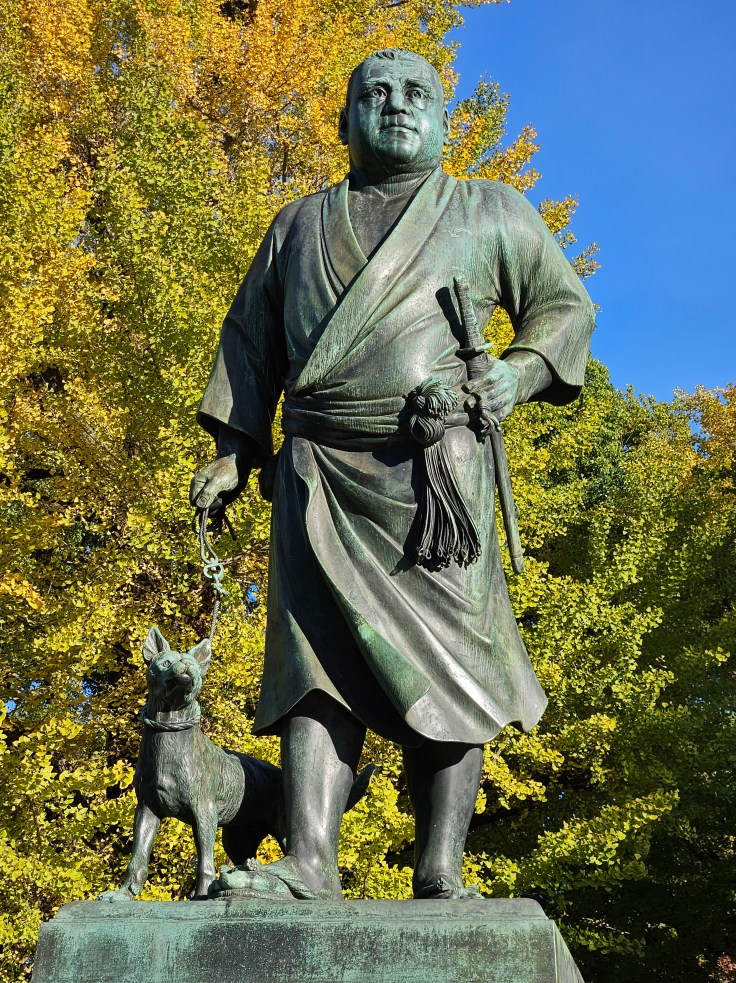
Once you leave the shrine, walk past the zoo entrance and make your way down to the southern tip of the park where you can find a monument to the samurai who fell in battle here. Not far from that memorial is a statue of Saigō Takamori, a samurai who fought on the imperial side of the conflict and negotiated a bloodless surrender of Edo Castle. He was initially a counselor to the Meiji government but opposed the abolishment of the samurai class and eventually led a rebellion of his own against the government. He died at the battle of Shiroyama and is widely known as the last samurai. (Parts of this story are depicted in the 2003 movie The Last Samurai starring Tom Cruise and Ken Watanabe in the role of Saigō Takamori. It’s a decent watch if you want to get up to speed on this period of Japanese history.) Unless you read Japanese you won’t be able to figure any of this out from the statue of a smiling samurai walking his dog, but since you follow this blog you’ll know.
A Brewpub for Sheep Lovers
By now you should be filled with enough history and culture to last for a couple of days, so it’s time to find some beer and a little food. If you are ambitious and traveling with beer-loving companions you can hit all four of the stops on the proposed itinerary in one day. I possess considerable ambition for this kind of activity, but my wife has a more limited tolerance for beer crawls, so we spread our visit out over two days. If you are pressed for time you could easily opt out the last stop.
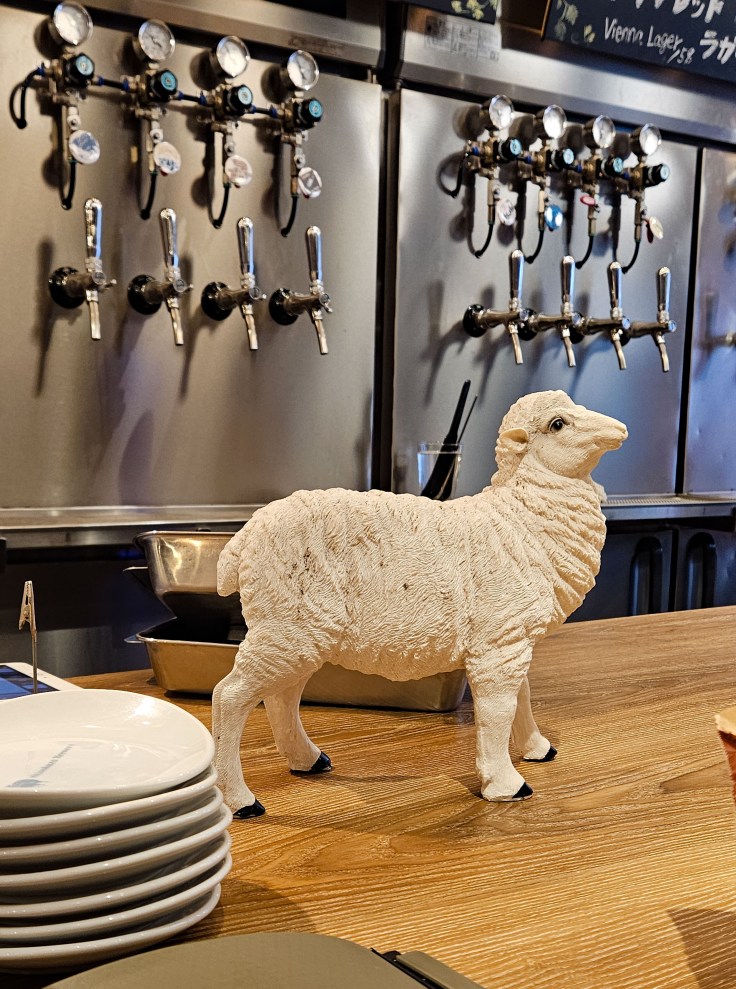
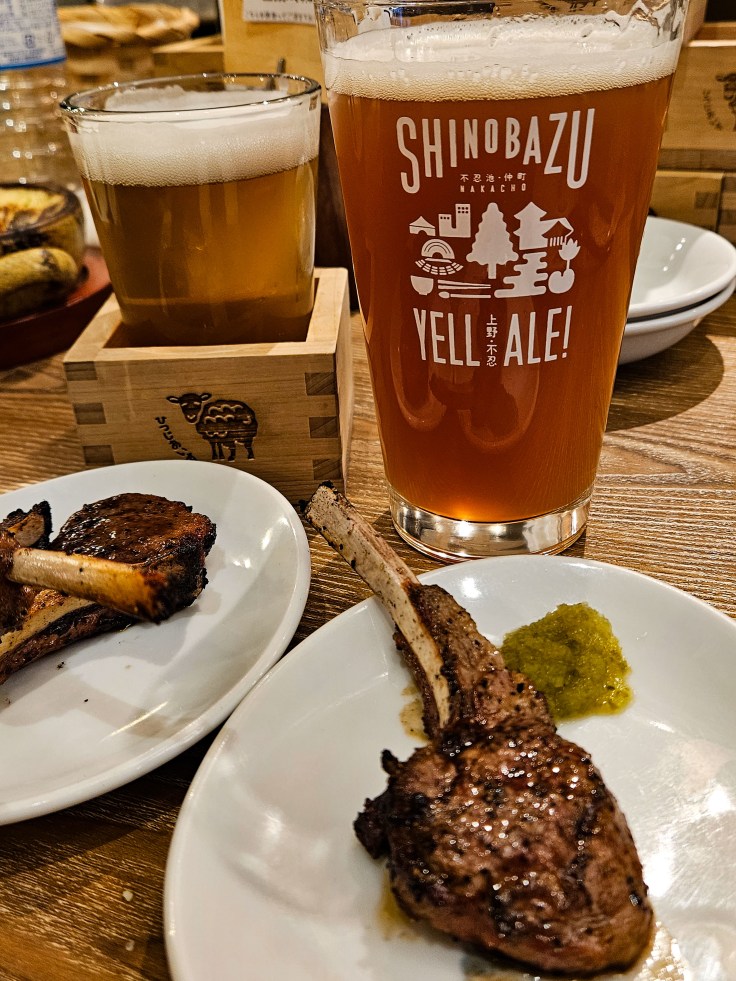
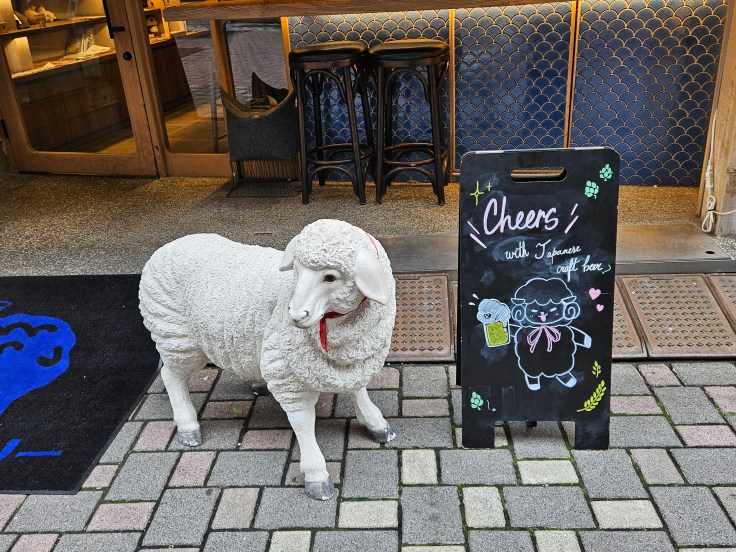
Our first stop, Shinobazu Brewery Hitsujiaisu, is a short walk from the southern end of the park. On the way there you can stroll by Shinobazu Pond, which lends its name to the brewery. The expansive pond is notable for being filled with lotus plants. I’m told they bloom from mid-June through August, and if you are lucky enough to visit during that time you should experience a beautiful view as partial compensation for the oppressive heat and humidity that comes with summer across much of Japan. The brewery was founded in late 2021 by Hiromi Maekawa, who wanted to combine his love of nearby Shinobazu Pond and all things sheep. In fact, hitsuji is Japanese for sheep and I believe hitsujiaisu means love of sheep (which takes a different meaning in some cultures, no offense New Zealanders). The beers here won’t knock your socks off but they are solid. The two flagship beers are a pale ale called Sheep Ale and a hazy IPA called YELL ALE! When I visited there were an additional four house brewed selections on tap, including a well-executed pilsner and Vienna lager. Confusingly the pale ale is lighter in color and hazier than the hazy IPA. For the first round my wife and I ordered the two flagship beers and when the bartender served us we assumed he switched our order. When my wife ordered another hazy IPA (YELL ALE!) we learned that our assumption was wrong. For what it’s worth, we both preferred the Sheep Ale, which features ample amounts of Mosaic and Nelson Sauvin hops. The inclusion of New Zealand hops is appropriate for the food that follows.
While the beer might not justify a special trip, the food here is well worth the journey. Nearly everything on the menu is based on lamb—shepherd’s pie, lamb and couscous tagine, lamb croquettes, french fries and deep fried lamb, lamb heart sashimi, lamb pate de campagne, and the signature dish New Zealand lamb chops (this is not an exhaustive list). I rarely eat lamb, but the food here was so good that I might want to rethink that policy. My wife is not generally a fan of lamb, she finds the gamey flavor off putting, but even she was impressed with the lamb chops and suggested we order more. As a bonus, our server Mike had recently moved to Japan from Portland, Oregon. It was nice to strike up a conversation with a “local” for a change. In the event Mike has the day off, there is an English menu.
THIS BREWING
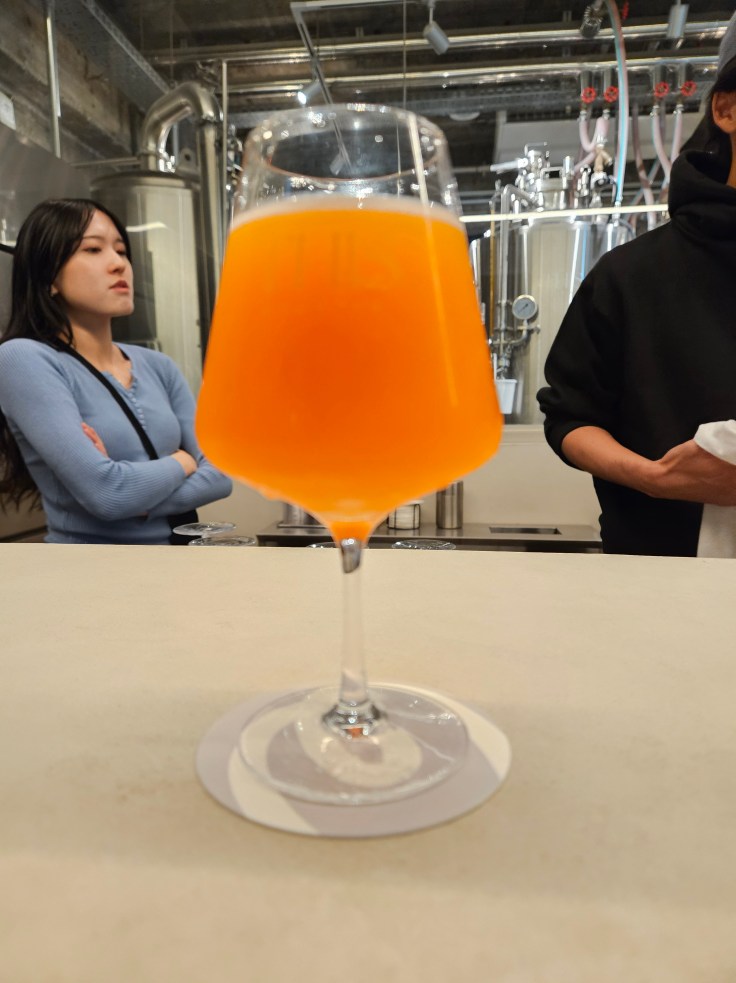
Our next stop, THIS BREWING, is a relatively short walk south from the Shinobazu Brewery. The nondescript blue tiled building located on a relatively quiet street makes for an unassuming presence, but the beers here are anything but ordinary. Despite the use of all caps to shout out the name of the brewery, the vibe on the inside is relaxed and friendly. The concept behind the brewery is to offer beers and experiences that capture the moment. As such, the beer list is constantly evolving and changing. The décor is minimalist, but clean. The bar is located on the ground floor and features a large door that retracts to open up the taproom to the surrounding neighborhood. There’s enough room for about half-dozen people to stand at the bar. Behind the bar is a glass window that offers a view of the stainless-steel tanks where the beer is made. If the bar is full, or you prefer not to stand, you can take your beer to the second floor where there are tables and enough chairs to seat 15 or so people.
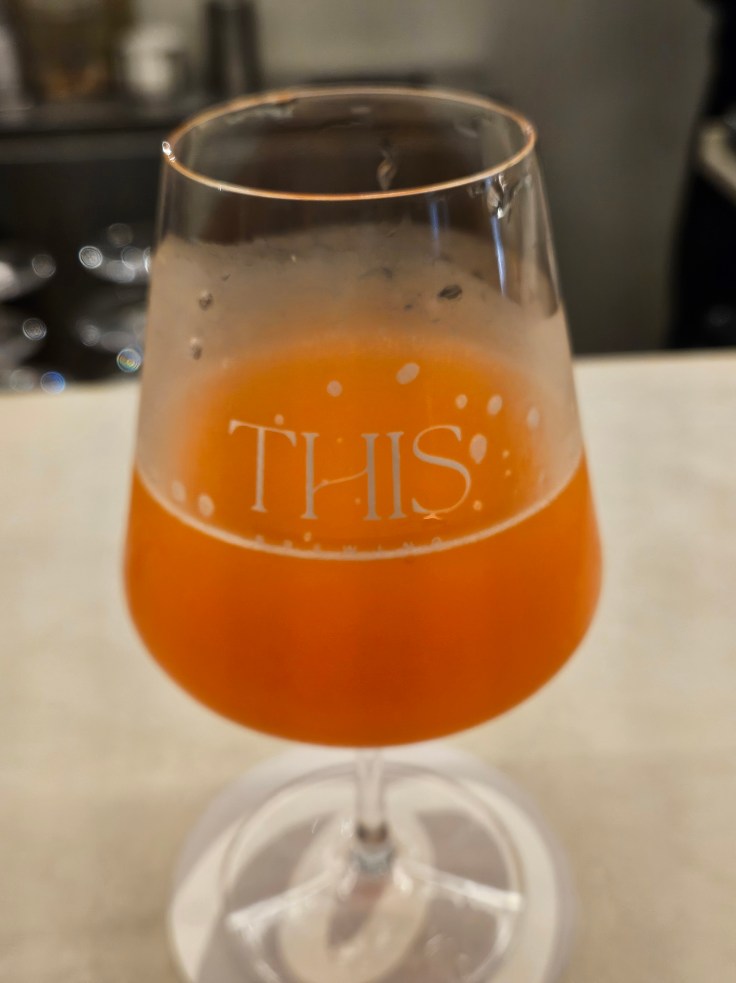
On the evening I visited there were eight beers on tap, with names such as this pale ale, this saison w/ chamomile and lemon, this wit w/ lime and cardamom, this hazy IPA, etc. They had two sours on offer, one with raspberries and one with carrots. The choice for a first beer wasn’t difficult; how often do you get a chance to try a carrot beer? Just to be clear, I’m not suggesting that more breweries should start adding random garden vegetables to their beers, but if you have any sense of adventure how could you not order the carrot ale? The orange-hued beer, no doubt brimming with beta-carotene, was served in an elegant Teku glass (it seems that all of the beers are served in this distinctive glassware). It was surprisingly delightful—tart but not too sour, with a distinctive carrot note that blends nicely with the base beer.
Even though I was the only English speaker at the bar, the vibe was friendly and one of the two bartenders did her best to strike up a conversation with me. When I finished my carrot ale they were quick to ask if I wanted another round. I asked for recommendations and they steered me to the pale ale with Earl Grey tea. Like the carrot ale, it was well balanced, clean and offered an interesting take on a well-known style. The quality of the beer here was among the best I’ve found in Japan. This is a brewery whose beers could easily hold their own in the US, but the atmosphere and patrons are all Japanese.
At this point, I’ll briefly comment about the prices of craft beer in Japan. At THIS BREWING the regular sized pours (roughly 330 mL or 12 oz) were ¥900 ($6) and the large pours (roughly 1 pint) were ¥1350 ($9). I would say this is pretty typical for breweries in Japan, though I have encountered some where the beers were as low as ¥500 to ¥600 for a regular pour and ¥900 to ¥1000 for a pint. Compared to prices of food and macro beer in Japan, craft beer is on the expensive side. For example, a good bowl of Ramen is typically around ¥1000 and dinner for two is often on the order of ¥3000 to ¥4000. However, compared to what you would pay for craft beer in the US, these prices are probably only slightly inflated (maybe not inflated at all depending on where you live).
Hitachino Beer Nest – Tokyo Distillery
When my wife joins me for this kind of trek some shopping typically works its way into the itinerary. On this particular trip we were looking to pick up vinyl records for someone back home and as a result our next intended stop was a vinyl shop called RECOfan (once again non-standard use of capital letters signaling something that is lost on me). The record store is located under the train tracks of the Yamanote line, and as it turns out there the space underneath this section of the Yamanote line is filled with shops that sell artisan goods and handcrafted items. If you are looking to pick up some things that are higher quality, less kitschy and more expensive than what you’ll find in the Ameyoko Market, you’ll appreciate this place. Even if you don’t buy anything, a stroll through these shops makes for some enjoyable window shopping.
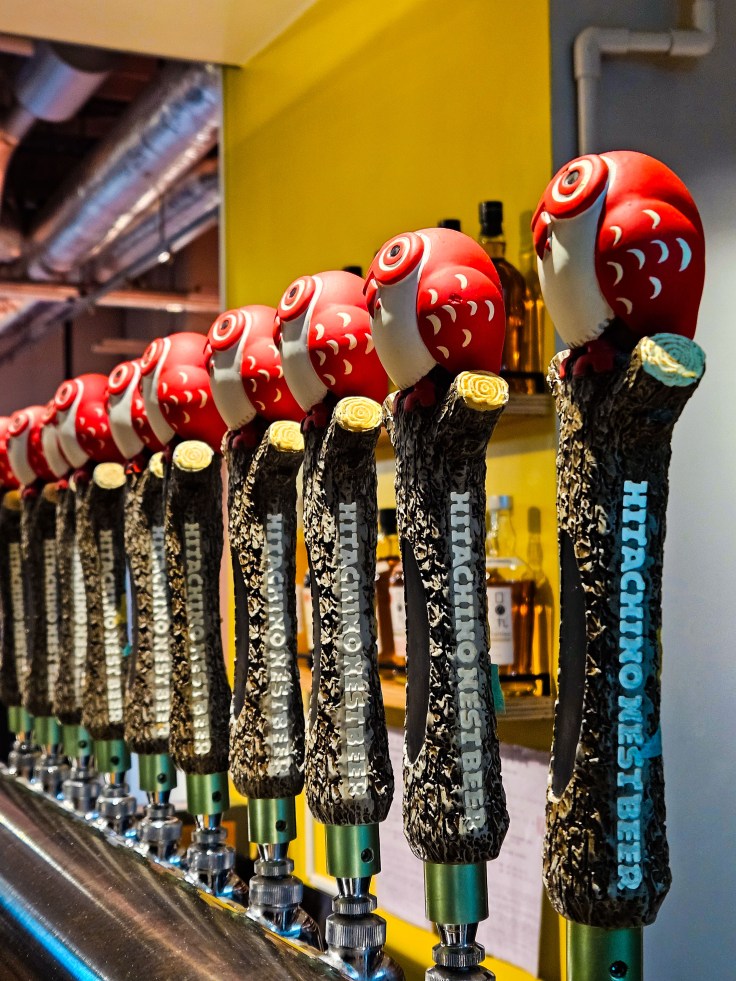
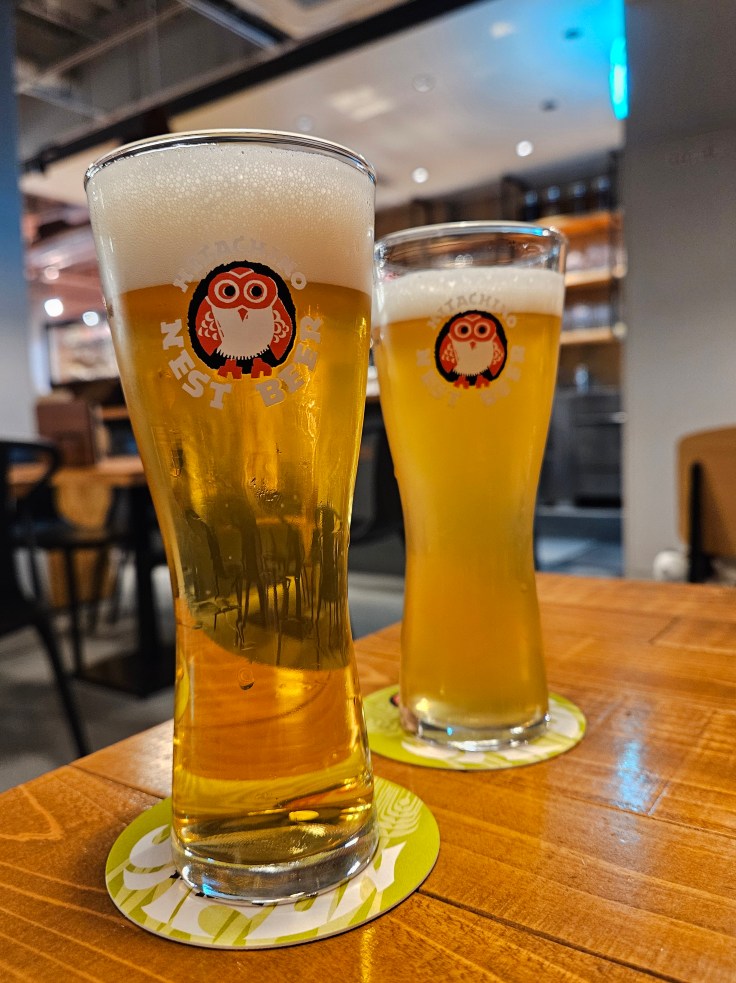
After perusing the vinyl at RECOfan (our search for something from the Kyoto based, all-female punk-rock-garage quartet Otoboke Beaver was unsuccessful) we stumbled upon one of many Tokyo taprooms operated by the Kiuchi Brewery. This venerable sake brewery (they’ve been brewing sake since 1823) launched the Hitachino Nest line of craft beers in 1996. If you are my age, you might be thinking that there were plenty of craft breweries around in 1996, but you wouldn’t think that if you grew up in Japan. Prior to 1994, a brewery needed to produce at least 2,000,000 L (17,000 bbl) of beer to be licensed. This effectively shut the door to all competitors aside from the large macro breweries (Asahi, Sapporo, Kirin, Suntory, …). The Kiuchi Brewery was one of a handful of groundbreaking craft breweries that came into existence in the late 1990s. As far as I know it is the only Japanese craft brewery that sells its beers across the US (or at least in Columbus, OH).
Not only is their owl logo cute in a way that is distinctively Japanese, the Hitachino Nest beers have won awards at serious international competitions. They’ve garnered World Beer Cup medals for their white ale (gold, 2004), Japanese Classic Ale aged in cedar barrels (silver, 2006), and their red rice ale (bronze, 2010). I’d love to visit the brewery, but it’s a 2.5 hour journey from Tokyo to northern Ibaraki Prefecture where the brewery is located, so the fact that they operate five taprooms in the Tokyo area is a nice convenience.
This outpost of Hitachino Brewing showcases their more recent expansion into distilled spirits, namely whiskey and gin. The taproom features a small still and there is an entire showcase for various whiskeys and gins made by the brewery. While whiskey is made exclusively at the main brewery in Ibaraki Prefecture, they do make some gin at this location. Intriguing, but I was content to stick with beer, so I ordered a glass of Nipponia 2025, a beer made entirely from Japanese ingredients. The grain bill consists of Kaneko Golden malt and Yamadanishiki rice, while the hops are two Japanese varietals, Sorachi Ace and Ibuki. I’d really wanted to love this beer, but I have to say that I’m not terribly fond of Japanese hops. When visiting Hokkaido, where Japanese hops are grown, I tried a couple of beers made entirely from Japanese ingredients and I had a similar take. I don’t mind a bit of Sorachi Ace as an accent note, but it doesn’t quite work for me when it has to carry most of the load. You may well have different taste preferences than I do, so don’t let me dissuade you from ordering a Nipponia, but if you want to try something else there are a lot of great options on the menu. In my opinion this brewery is one of the best at integrating Japanese ingredients into classic beer styles.
An Authentic British Pub in Ameyoko Market
At this point in the journey you have a decision to make. A mere 200 meters south of here is the bustling Akihabara station. From there you can jump on a train that will take you to nearly anywhere in Tokyo. The options are limitless, so I won’t even attempt to elaborate. However, if you are up for more beer and hankering for something from the British Isles, my recommendation is to take the Yamanote Line north to Okachimachi Station and then continue on foot for another 5 minutes through the streets of the Ameyoko Market where you will find a cozy British-style pub called The Warrior Celt. Logistically it would have made sense to stop here after leaving Ueno Park, but they don’t open until 5 pm, so chances are they wouldn’t have been open. As an added bonus, if you are staying near Ueno Park this route will bring you back close to your hotel.
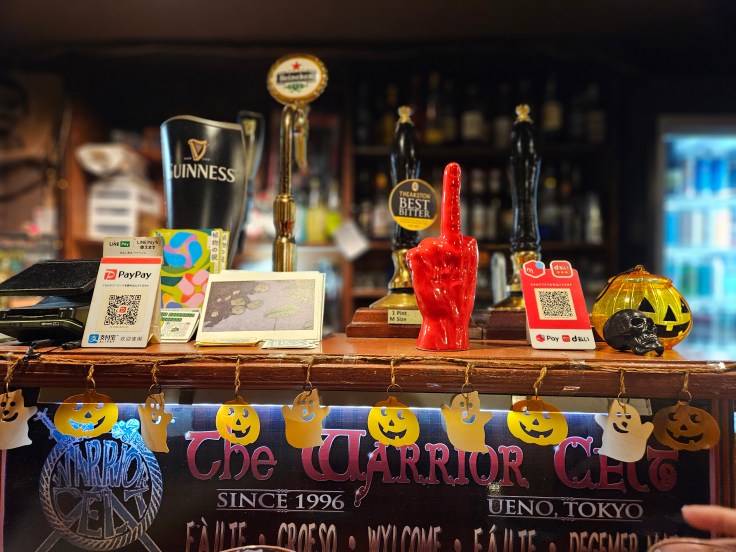
Our previous two stops, THIS BREWING and Hitachino Nest, are quintessential Japanese craft breweries – clean, refined décor, populated by people who are either engaged in quiet conversation or enjoying their libations in silence. The Warrior Celt is different in almost every way imaginable. For starters, you must ascend a steep staircase to the third floor to access the pub. Upon entering you’ll find a moderately sized (by Japanese standards), dimly lit room featuring dark wood paneling covered somewhat haphazardly in photos and flags and concert posters. On the bar there is a bright red ceramic figure of a hand giving you the middle finger.
We arrived around 9 pm on a Friday night. The tables were mostly occupied, but there were some open seats at the bar so we cozied up to the bar and ordered a couple of pints. From the name I was expecting this to be an Irish Pub, and they do serve proper pints of Guinness here, but aside Guinness and Heineken nearly all of the beers were from Britain, including the bottles and cans. The look of the tap handles suggests they serve cask ale, which in retrospect seems improbable given the fact that England is on the other side of the world. It turns out the draft beers are served on keg, which is probably just as well. I was excited to see Theakston’s Best Bitter on the taplist, so I ordered a pint. Our visit coincided with Halloween, so about half the patrons were in some type of costume. There was a good mix of people from Japan and westerners, quite possibly expats living in Tokyo. It’s hard to say for sure, but I can say with certainty that we weren’t the only ones ordering in English.
By this point you might be hitting your stride. If so, you could keep going with 4% pints of bitter or stout while waiting for the live music to start (no idea when that happens, but it seems to be a thing at the Warrior Celt. The bar is open until 5 am on the weekends). The wise move would be to get some more food, either here or at one of the many izakayas located in Ameyoka and then get some rest for another day out on the streets of Tokyo. In our next journey we’ll branch out to the neighborhoods of Asakusa and Sumida that lie just east of Ueno.


Leave a Reply